

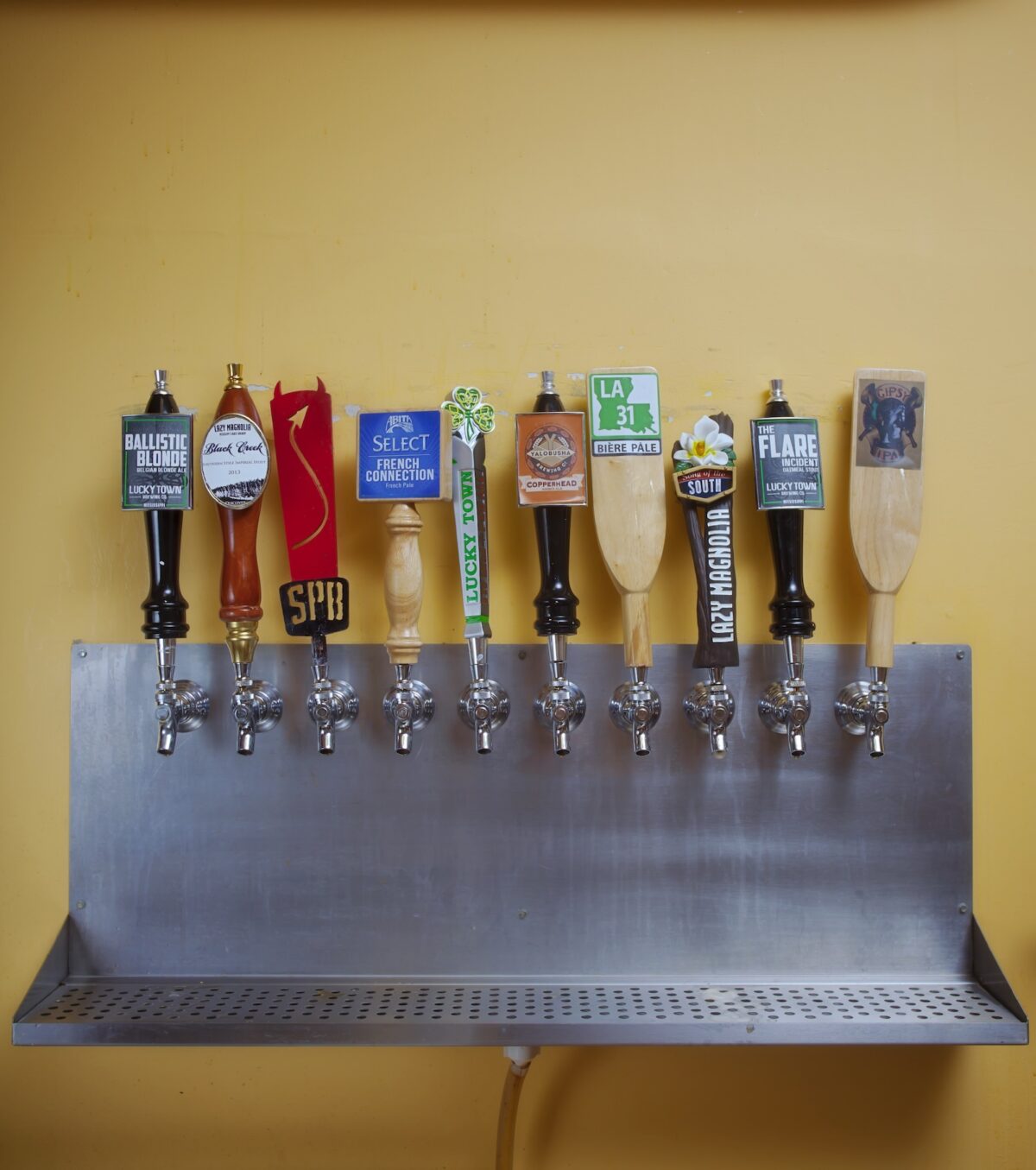
From the river to the beach, the capital to the Hill Country, a craft beer revolution is sweeping Mississippi. With seven active breweries, one almost ready to open, three homebrew shops and watering holes in nearly every major city in the state, Mississippians are whetting their whistles with a wider array of frothy favorites.
The revolution is most astounding considering Mississippi’s less-than-beer-friendly historical culture.
Nine years ago, however, when the state’s lone brewery, Lazy Magnolia, was still in its infancy, a beer-loving bar owner in Hattiesburg foresaw the possibilities.
John Neal is now reaping benefits that still boggle his imagination. His Keg and Barrel on Hardy Street in Hattiesburg is widely considered the best craft beer bar in the state. It was the birthplace of Raise Your Pints Mississippi, an organization that would change the culture forever, and had more taps, 36, than any bar in the state.
John realized there were people who desperately wanted to pass on the thin yellow fizz commonly found on Mississippi taps for a brew with a backbone, a lips-pursing hop bitterness, crafted in small batches for a down-home feel.
John and brewer Sam Sorrells, who eventually left K&B to open Hattiesburg’s Gordon Creek Brewery, created the state’s first brew pub, which offered both beer made in-house and brews from established national craft breweries. (Sam opened Gordon Creek Brewery downtown in 2013, but in late August of this year, announced that his brewery was closing due to several reasons, including funding.)
It was a slow-go at first, though, as the state’s antiquated beer laws kept many of the best selections out of the state. Even now, nearly a decade after opening the K&B, John shakes his head when he ponders the massive growth of craft beer in the state.
“I never, ever thought it would get this big,” said John, whose restaurant now features 64 taps as the highest-volume craft beer bar in Mississippi.
So how has Mississippi gone from one brewery to seven, with more in the planning stages?
First, let’s take a look back at Mississippi beer history
In 1918, a constitutional amendment that would ban the manufacture, sale and transportation of alcoholic beverages in the United States and its possessions was waiting for states to ratify it. Mississippi became first to sign on, voting Jan. 8, 1918, to pass Prohibition.
States followed suit in 1920 and, for the next 12 years and a few days, the country went legally dry after the 18th Amendment to the Constitution was approved.
On Dec. 5, 1933, the 21st Amendment to the U.S. Constitution took effect, the only amendment to be repealed. It allowed states to make their own laws regarding alcohol.
As revelers rang in the end of Prohibition, Mississippi chose not to join in the party. No, not until 1966, 33 years after the rest of the nation, did the state end its prohibition of alcohol. However, many counties remained dry. More than 20 counties in Mississippi remain dry today, but in many of those, cities have declared themselves wet. In Jones County, for instance, beer is available and legal in Laurel and Ellisville, but it is illegal to possess anywhere else in the county.
After the law’s change, the state still found itself far from a beer mecca. Into the late 1990s and 2000s, if a patron wanted a craft beer in Mississippi, it took a long, hard search to find it. A few of the craft brews that survived the first national revolution in the 1980s, such as Sierra Nevada and Samuel Adams, could be procured in this state, but only a few European beers were available.
John set the trend in the late ’90s when he opened Keg and Barrel, Mississippi’s first and only brewpub. Under then-state law, beer could be brewed in an establishment that served food, but that beer could not be packaged or sold out of the restaurant.
Tucked in a closet-sized room behind the beer taps is the original Southern Prohibition Brewery. Sam and John had created a niche all of their own.
The beer was receiving rave reviews and business was bustling, but the two ended their business relationship, and Sam opened Gordon Creek while John wanted to expand beyond the small brewpub system.
State law, though, would not allow a business to brew beer for retail and serve it onsite at the same time. So, John diverged the Keg and Barrel of the brewery, which moved into a Mobile Street warehouse. He had to relinquish control to Quinby Chunn. The brewery could can and keg its beer for sale, and the Keg and Barrel could serve it.
Early resistance to craft beer fell squarely on the old beer laws that did not allow beer to be above 5 percent alcohol by weight. Large craft breweries scoffed at having a footprint here because many of their beers easily exceeded the 5 percent threshold.
That would all change when a group of five people, three from the Jackson Metro area and two from Hattiesburg, with a love of beer in common, formed the group “Mississippians for Economic and Beverage Advancement,” a name each will happily tell anyone is terrible.
That group morphed into Raise Your Pints Mississippi in 2007. Its members immediately began lobbying state government for changes to Mississippi’s beer laws. The craftier, more expensive beers routinely came in over the 5 percent cap. At one point, 90 of the top 100 beers as chosen by Beer Advocate, an online beer resource website, were unavailable in Mississippi.
Craig Hendry, Butch Bailey, David “Soup” Campbell, along with Todd and Katie Parkman met at the K&B to brainstorm. They then set out on a mission. Three years of fundraising, cajoling with brewers for donations and pleading with legislators to end the Prohibition-era stranglehold on beer, and things went nowhere.
The fiercest resistance came from lawmakers, who refused to let a beer bill out of committee.
Frustration mounted among RYP members, but a growing groundswell of support from craft beer drinkers kept the group moving forward.
In the fourth year, RYP hired a lobbyist. In 2012, Gov. Phil Bryant signed a beer law raising the allowable alcohol in beer in Mississippi to rise to 8 percent by weight, which equals about 10.2 percent by volume.
The results were so amazing other special interest groups began asking RYP to lobby for them.
“We’re not surprised at all by the tremendous growth of Mississippi’s beer industry the last two years,” Hendry said. “It’s what we were expecting and was a reason RYP fought so hard to get it done. We knew of the positives it would bring to the state.”
Store shelves began filling with craft beers never before seen here. Following that trend, one brewery in the state evolved into breweries popping up across the landscape from Oxford to the Gulf Coast.
The first, Lazy Magnolia of Kiln in Hancock County, began producing beer commercially from a warehouse near a small airport in 2003. Lazy Mag started distributing in party pigs, five gallons filled inside a pig-shaped vessel allowing for draft beer at home. The company also played to the craft-beer-craving college towns, offering Reb Ale only in Oxford and Southern Gold only in Hattiesburg.
But, as the company started by husband-and-wife team Mark and Leslie Henderson continued to grow, they began bottling. Southern Pecan quickly became the company’s flagship beer, the only beer brewed with whole roasted pecans.
One year after the alcohol bill passed, the state legislature passed a homebrewing bill allowing residents to brew up to 100 gallons of beer per year, but it could not be sold.
As the beer laws were relaxed, the market responded. Four friends from Jackson founded Lucky Town Brewing Company.
“I think the market has been there all along,” said Lucas Simmons, head brewer at Lucky Town. “It took the laws being changed to get the growth more rapid.”
They had begun making a name for their product before Lucky Town was a brewery when they won best big beer at the inaugural Keg and Barrel Outlaw Homebrew Competition in 2009. Homebrewing was still four years from becoming legal, but John has never been afraid to take chances. The inaugural event drew home brewers from four states.
Award-winners at those early shows are making names for themselves now in the regional beer community. Outlaw winner Will Brown is a brewer at Lazy Magnolia and won a first-place at the inaugural competition. Ben Green is head brewer at Southern Prohibition and won Best-in-Show three years ago. Dan Murphy, head brewer at Alabama’s Fairhope Brewing Co., won first-place for his Black IPA, a beer he still produces at the Lower Alabama brewery. Louisiana’s Chafunkta Brewing Company of Mandeville also participated in the Outlaw competition before the brewery went professional.
“That is something, isn’t it?” John said.
Lucky Town was hoping to begin producing beer at its Mill Street location in Jackson in mid-September. It has been contract brewing at Back Forty in Gadsden, Ala.
The growth of beer in Mississippi is also leading to the creation of the Mississippi Beer Trail, where beer-lovers can travel from the Coast all the way north to Oxford to experience Mississippi’s beer revolution by touring the breweries.
Seven breweries are in operation from the big, Lazy Magnolia, to the small, Mississippi Brewing Company of Gulfport, which only produces beer one barrel, or 31 gallons, at a time. To put it in perspective, Samuel Adams produced about 2.7 million barrels in 2013.
Mississippi Brewing’s beer is not packaged or available in stores, but it is available at the brew pub and gumbo house in Gulfport. They have eight beers on tap with four seasonal selections. Known as a nano brewery, they pride themselves on serving it “one pint at a time.”
Crooked Letter Brewing, based in Ocean Springs, became the third brewery into the Mississippi market and just began bottling. Their flagship Mystery Romp is a coffee oatmeal stout, rich and thick, with a pronounced chocolate and coffee flavor.
Crooked Letter’s bottles are available from Jackson south. The company plans to increase its distribution north as the calendar moves into 2015. They brew eight beers and are not afraid to be experimental.
On the beer trail north, Hattiesburg’s Southern Prohibition occupies a warehouse on Mobile Street. SoPro produces 3,000 barrels of beer per year and theirs is available on tap and in 16-ounce cans throughout the state. Friday tours include samples and a walk through the brewery.
After leaving Hattiesburg, the trail heads west to the Mississippi River where a couple with a thirst for craft beer sees an opportunity in one of the most historic downtowns in the state.
Pending a federal permit, Natchez Brewing will open by the end of the year, according to co-owner Lisa Miller, who is opening the business with her husband, Pat.
The brewery will be small, a three-barrel system to start, and might expand to six barrels, if the market is right, Lisa Miller said.
“We are not trying to be a Southern Prohibition or a Lazy Magnolia,” she said. “We just want to brew good, quality beer and stay within our limits.”
Pat Miller began home brewing while living in Asheville, N.C., a craft beer mecca. But when they moved to Natchez in 2012 to be closer to family, they saw craft beer selections lacking.
Their beers will play off the city’s traditions, with its Bluff City Blonde, Old Capital IPA, Silver Street Pale Ale and Revival Pecan Coffee Porter. Lisa Miller also said the brewery will offer seasonal selections.
A jaunt up the Natchez Trace, an experience in its own, will take visitors to Lucky Town. Simmons said they will have a tasting room and offer tours once the final touches are put on the brewery.
While South Mississippi is dominating the brewery market, a couple upstarts in the north are making waves.
In Water Valley, the Yalobusha Brewing Company is leading a revitalization of downtown. The brewery pays homage to the name of the county and the river that runs through it. It occupies a former machine shop on Main Street.
Yalobusha distributes in Mississippi and Louisiana and their flagship beer is the 6 percent Miss-iss-IPA.
Keep traveling north to Oxford, the home of the Ole Miss Rebels and now the Oxford Brewing Company. They produce Sorority Blonde Ale and MPA No. 8, a pale ale that has won several awards at state homebrew competitions.
The Mississippi market is still ripe for additional breweries. A budding group of home brewers who span the state should lead to more of them venturing out to become professionals.
For that reason, along with the fact that Mississippians are thirsting for additional craft beer selections, more breweries are being rumored throughout the Mississippi beer community. Cleveland, Vicksburg and Laurel are possible future brewery locations, but no official announcements have been made. If Mississippi looks to its neighbors in Alabama, the brewery revolution is far from over.
In the last decade, 14 breweries and four brewpubs have opened in Alabama. Fourteen others are in the planning stages.
The next step for Mississippi brewers is gaining the ability to sell beer onsite. Currently, if a brewery offers tours, it is allowed to provide samples but cannot sell beer. This law was one of the reasons for Gordon Creek’s closing.
Legislation failed in the last session that would have allowed for the sale of beer on premises. Lucky Town’s Simmons said if breweries had that option, they could do much more, including small-batch offerings and experimental brews.
The United States currently has 3,000 breweries, by far the most in the history of the country. More than 4,500 brewers have applied for licenses. According to the Brewers Association, 2,403 breweries existed in 2012, which was the highest number since before 1890 when there were 2,000 breweries.
In the years after Prohibition, the brewery count topped out at 703 before falling to fewer than 100 in the mid-1970s.
And, there is no sign of Mississippi’s craft beer revolution slowing down, either.
“The well-capitalized breweries, the ones that know what they are doing, they will be just fine,” John said.
“When the signature hit the paper on both laws it was a sense of relief and accomplishment and great feeling of anticipation for what we knew was about to come to Mississippi.”
Craig Hendry, president, Raise Your Pints Mississippi
STORY Sean Murphy
PHOTOGRAPHY Melanie Thortis