

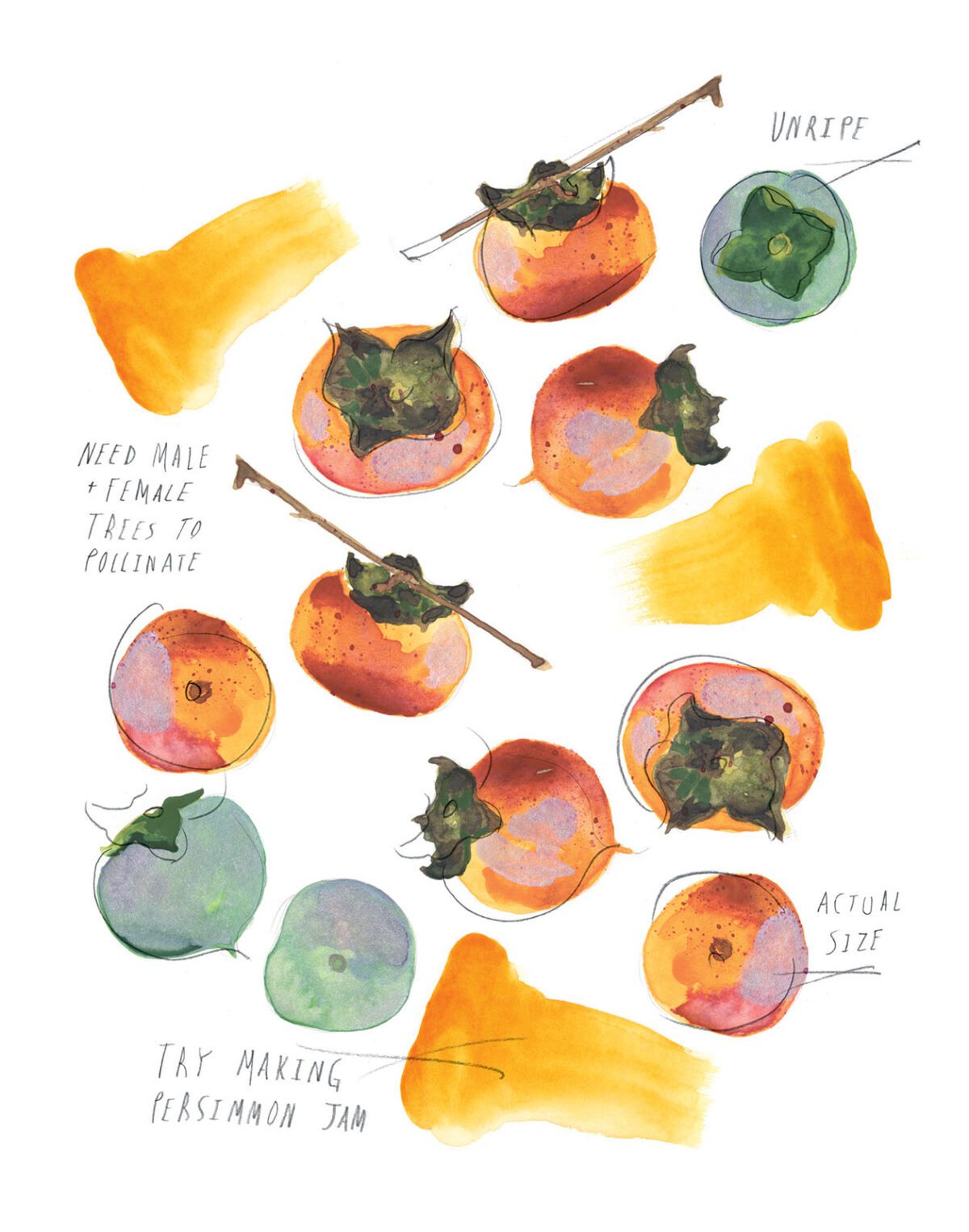
The Mississippi persimmon grows wild and produces a bitter and astringent fruit that becomes sweet once it matures.
Illustrations by Jamie Runnells
(Diospyros virginiana)
Common to the Southeast, the persimmon is great for jams, beer or a tasty concoction using fresh honey. Unlike most other species of producing trees, the persimmon must have a male and a female to make the tasty fruit, and the female doesn’t produce until it’s 5 to 8 years old.
Folklore suggests persimmon fruits — once they’re soft to the touch and the seed is sliced long-ways — can help predict the coming winter. A spoon- or snow shovel-shaped embryo means a lot of snow is on the way; one shaped like a fork (good eating) indicates a mild winter; and a knife-shaped embryo tells us to look for a cold and icy winter, the knife representing chilling, cutting winds.
Folklore suggests persimmon fruits can help determine the severity of the upcoming winter. Once the fruit is soft to the touch, the large seed can be sliced longitudinally to predict impending winter conditions. A spoon-shaped embryo indicates lots of snow (spoon representative of a snow shovel), a fork-shaped embryo indicates a mild winter (fork representative for ‘good eating’) and a knife-shape indicating a cold and icy winter (knife representative for chilling, cutting winds).
The common persimmon is a tree found throughout the Southeast United States and is a quite, well, common tree in Mississippi. The common persimmon is a valuable tree that’s easy to identify and possesses a unique history of use and folklore. It also offers a wonderfully flavorful fruit. In fact, the scientific name, Diospyros, means “divine fruit.” Persimmons grow wild and are easy to identify with their dark, blocky bark on mature trees and fuzzy young twigs and buds. A unique characteristic of this species is that it has male and female flowers on separate trees. That means a male tree will never produce fruit, while a female tree will produce fruits when it reaches maturity (between 5 and 8 years). This variation in individual trees is termed ‘dioecious’ and is worth consideration if one wishes to plant persimmon trees around a home. Male and female trees are needed to ensure successful pollination.
Before it ripens, the fruit is bitter and quite astringent — imagine taking a bite of Orajel toothache cream! But, when persimmons are ripe — typically after the first frost — there’s not a sweeter fruit to be found. I grew up eating persimmons while hunting and exploring the woods in the fall. I’ve used them to make jams, persimmon porter beer and a tasty fermented melomel using fresh honey.
During the Civil War, the Confederacy is noted to have used the large-sized seeds of the common persimmon as replacement buttons. Soldiers also roasted the seeds and ground them for use as a coffee substitute. The dense wood is hard and shock-resistant, which had led people to use it for driver golf clubs and gunstocks, mallets, and the like.
STORY Nathan Beane
ILLUSTRATIONS Jamie Runnells
