

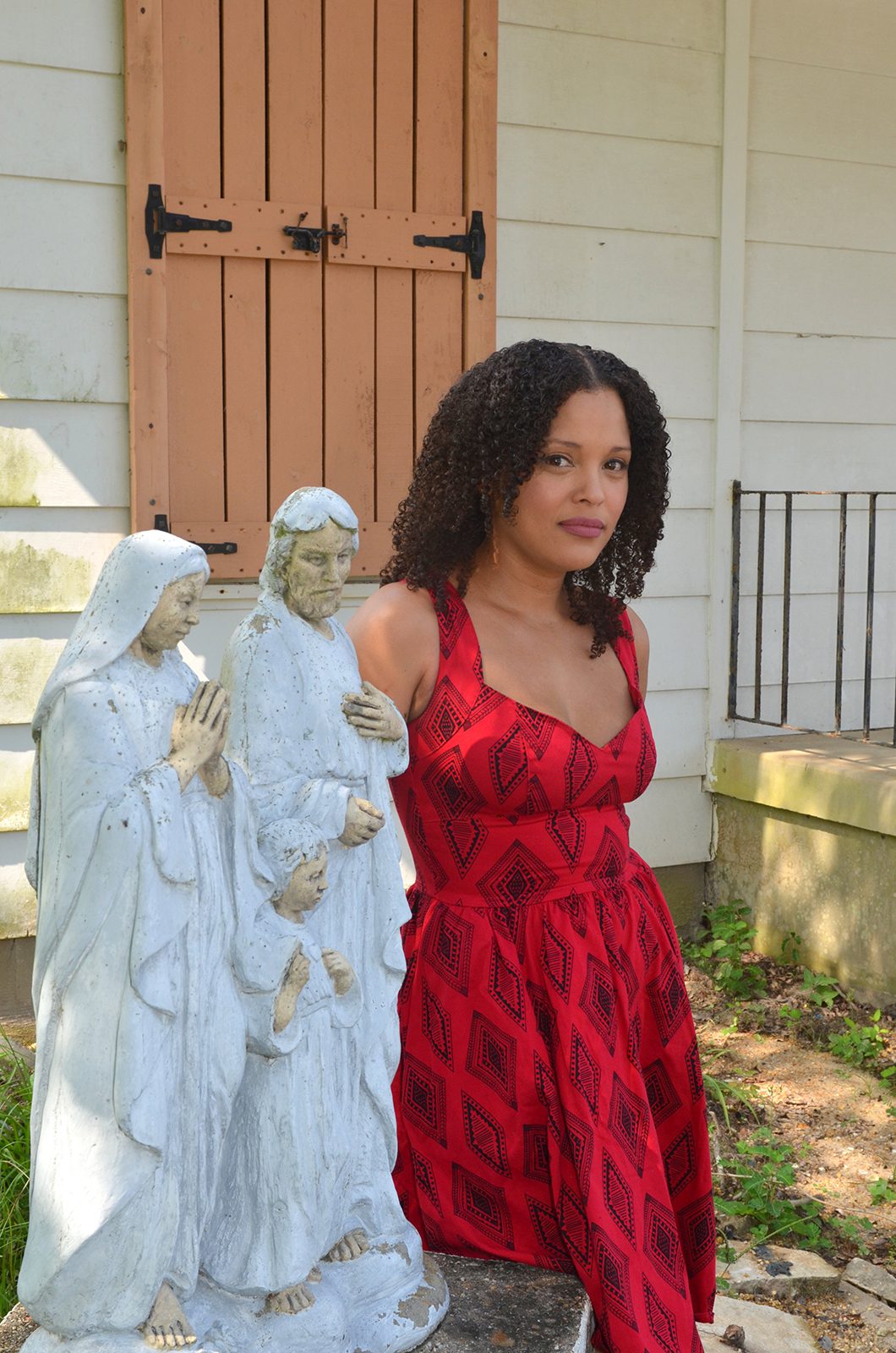
All the stories of author Jesmyn Ward point to the South, most specifically to the home of her childhood, DeLisle. The 38-year-old mother of a 2-year-old has penned three books and, in the footsteps of Southern literary giants, has relied on her homeland for the foundation.
Her first two novels, Where the Line Bleeds and Salvage the Bones, which earned for her the 2011 National Book Award, are set in the fictional Gulf Coast town of Bois Sauvage.
Her third work, a memoir titled Men We Reaped, details the difficult story of five young men, including her brother, Joshua, who died in four years. They were all in their late teens or early 20s. They were all black. They were all from DeLisle.
Ward allows her work to show how deeply she was entrenched in a world of being poor and black in a rural and modern American South. Themes of race, religion, family and community set the stages.
Salvage the Bones is prefaced with three quotes: a verse from Deuteronomy; a line from Spanish poet Gloria Fuertes; and a lyric from an Outkast song. For readers, she’s eliciting something Biblical, something literary and something cultural. Her sense of place is entangled in her characters.
Ward was born in Berkeley, Calif., where her mother was attending a community college. They moved to her family’s hometown of DeLisle while she was still a toddler, uniting her with generations of the family who lived in the same neighborhood.
In the early 1980s, Ward’s family “fell on hard times,” she said. Her parents and three siblings moved in with her grandmother, for a while bringing to 13 the number of people under one roof. As the eldest child in her immediate family, Ward often was called on to help watch her younger brother and sisters.
At school, she was bullied, but she found solace in reading.
“My love of writing came from my love of reading,” she said.
In the second grade, she was placed in a program for gifted children that required students to complete reading-enrichment packets.
“All of the other girls in the class hated doing the reading packets,” she recalled.
She took a stance.
“I remember one day grabbing a reading packet and thinking to myself, ‘I’m not going to be like everyone else,’” she said. “It wasn’t this natural thing that I realized. I just made this decision.”
So began her love affair with books. The Secret Garden, Harriet the Spy, Island of the Blue Dolphins. She devoured them one by one, running her hands along the spines in her school library, scanning the titles. Looking back, she was always drawn to novels with a strong, female protagonist.
Ward adored reading, but could not imagine herself a writer. She didn’t journal or write creatively until the sixth grade when she and her classmates were asked to write poems for Arbor Day. Then she was asked by her teacher to read hers aloud at a school program.
“That was the first time that I felt like I did some kind of creative writing and people responded positively,” Ward said.
She wrote “bad short stories” and poems throughout high school, but when she got to college at Stanford University, she felt overwhelmed and out of place among some of the nation’s most competitive students.
“I didn’t seriously pursue it in college because I didn’t think I had the talent or know-how,” she said.
With an undergraduate degree in English from Stanford, Ward decided to pursue a master’s, believing that would aid her job prospects. She sought work while finishing college, but was forced to move home when nothing panned out. Her job struggles continued, leaving her to take a holiday job at an outlet mall to make ends meet. The grind led her to venture out once again, this time to New York and sleeping on couches until she landed a position at Random House.
At the prestigious publishing company, she edited other people’s works, secretly yearning to make a serious effort for her own novel. She learned about the book publishing industry and realized she had two options if she wanted to be a full-time writer: Work a 9-to-5 job and write at night, teaching herself how to get better at her art; or pursue a master’s degree in creative writing, all the while learning from experts and devoting her time to studying.
“You have to have a lot of discipline, and it’s really hard. It’s hard to work a full-time job, and then come home and discipline yourself to seriously become a better artist,” she said. “I couldn’t do it.”
Ward applied for scholarships to various Master’s of Fine Arts programs and eventually was accepted at the University of Michigan, where she wrote her first novel and worked for three years to have it published.
She began teaching college-level English and writing courses, eventually returning to Stanford for the Stegner Fellowship Creative Writing Program. There she wrote her second novel. Later, while working as the Grisham Writer-in-Residence at the University of Mississippi, she wrote her third book and most mentally challenging — her memoir, Men We Reaped.
“Oxford is a very ghost-rich place,” she said, telling how William Faulkner’s home, Rowan Oak, can be seen from the window of the writer’s residence. But, she was intimidated by the open wounds of losing her brother and four others to tragedies she traces to a cycle of poverty and oppression for many blacks in the South.
“All of these issues … all of those things weighed heavily. I was living in a huge house by myself and working on a manuscript that was taking a lot out of me and was making me relive my ghosts every day. It was really tough,” she said.
“I wanted to write about the experiences of the poor and the black and the rural people of the South so that the culture that had marginalized us for so long would see that our stories were as universal, our lives as fraught and lovely and important as theirs,” Ward told her audience as she accepted the National Book Award in 2011.
Today, Ward is working on her fourth book, a return to fiction and the town of Bois Sauvage. She is elated to be completing a final draft of the novel, having worked on it for three years while caring for her daughter and teaching in New Orleans.
As she writes at her home in DeLisle, Ward is surrounded by the ghosts and experiences that continue to find themselves on her pages.
“When I was a kid, I thought what authors accomplished was a kind of magic. They created these books,” she said. “As I got older, I understood that it’s not magic, it’s work.”
STORY Camille Breland
PHOTOGRAPHY Kim Welsh