

JACKSON — On an early autumn evening at Belhaven University, a medley of mixed-gray hair and the fresh faces of youth is present at the school’s annual homecoming celebration. It’s a decidedly well-behaved affair, a tapestry of buttoned plaids, modest dresses and mild manners. On this particular night, it feels postcard idyllic — exactly the place you wouldn’t mind leaving your child for a wholesome college experience.
That’s just how Harrison Scott Key remembers it.
Key is back on the campus where he made his final sprint to manhood, after leaving the shadow of the father who factored so prominently in his life, and became, posthumously, the central figure of “The World’s Largest Man: A Memoir” (HarperCollins), the book Key is signing for friends, fans and former professors in the lobby of the auditorium.
The crowd will soon hear tales of late-youth gone wild as Key winds his way through the back roads of his college life. The first laughs come during the introduction, as a classmate remembers Key and a coterie of friends riding bikes up a ramp and crashing into a fountain on campus.
Over coffee the next morning, he recalled the time he and his buddies rappelled into the pre-renovation King Edward hotel ballroom from the rooftop.
Key’s talk was part reminiscence and part book reading, but mostly a stand-up routine honed over the summer on his first book. The slideshow portion is a special homecoming treat for his friends, filled with faded snapshots wherein Key looks very much like a young, wild-eyed Andy Kaufmann.
The stories seem almost too fantastic. But, this was another time, two decades ago, when students like Key felt as if they were given the keys, as he describes, to “an abandoned Christian summer camp.” In other words, he had just as much room as he needed.
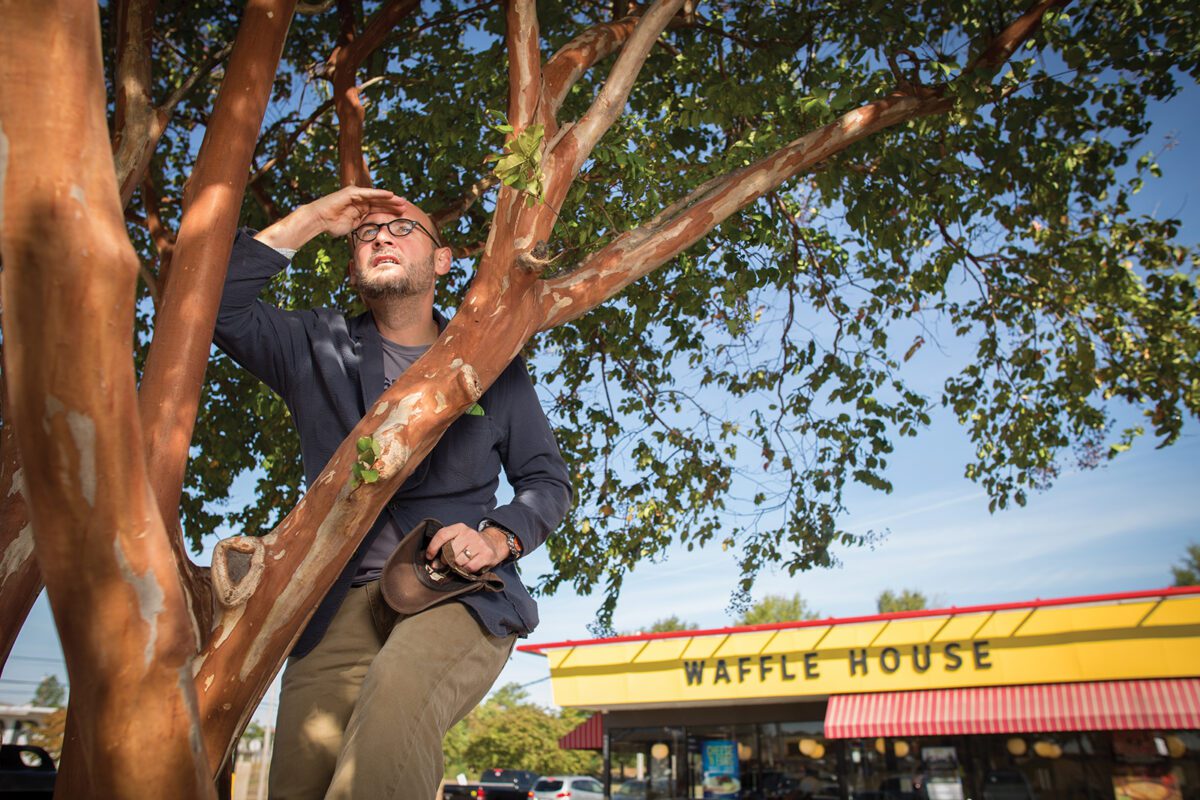
The next morning, he picks up the narrative over hash browns and coffee at a nearby Waffle House.
“Once I got to Belhaven, I felt that I had so much in me,” he said. “At home, I could be a little bit myself, but not too much. I think school was the place for me to do and say and write crazy things that I couldn’t say at the dinner table.”
Key found places in Jackson where he could relax after classes, talk music, read books, debate topics with the other regulars and get a cheap meal and a good bottomless cup of coffee. He was kicked out of this particular Waffle House for not ordering enough food on a Christmas morning when an ice storm prevented him from driving to his grandparents’ home in Coldwater.
“In a very conservative, family-oriented bedroom place like Jackson, for me, the only place you could encounter people with interesting or strange ideas was a bar or a place like the Waffle House or Tastee Donuts,” Key said.
“I can’t decide if I became a writer because I liked being in places like that and needed something to do while I was smoking and talking, or if I was coming to places like this because I was a writer. I don’t know which came first.”
Key’s first break as a writer came years later when, from the back row of a Q&A session at a writer’s conference, he challenged then-Oxford American editor Marc Smirnoff to read his manuscript. That eventually led to his first byline in the Southern literary magazine.
His next one came in a similar grand fashion. After meeting and bonding over drinks with Spin founder Bob Guccione Jr., the night before a nonfiction conference at Ole Miss. Key got a boost when his new pal rushed the podium after Key’s reading with an agent in tow, urging her to sign him immediately or lose out on discovering the next big genius writer.
“He was just being funny, being nice,” Key recalled. “But he knew what he was doing. He was getting me an agent. And I signed with her a week later.”
Key’s life seems to be defined by these larger-than-life people and moments. There are his family members, including his seemingly monolithic father, and the folks he encountered at deer camp, which some media types simply can’t believe actually exist. Key has had to explain to more than one interviewer that, yes, his cousin actually tried to stab a deer in the throat while piloting a boat down a river.
“I like to show people pictures so they understand that these people are real. I’ve been asked so many times, ‘How much of this is exaggerated?’ Well, when I describe my father’s head as being the size of the Death Star — that’s an exaggeration,” he said.
But, people who are from the South, he said, often nod in understanding that their own family trees are filled with the same eccentrics and salt-of-the-Earth, rebel-yellin’ types.
“When I realized I was related to these people, I realized that I was really telling stories about hunting for my people,” he said. “For me, this was a mystery book. ‘Who are my people? And how can I possibly be related to the man who is my father?’”
The journey to that place was as straight as a trot line bent and dragged by the current of the Pearl River. Over a four-year period, Key spent his early mornings before teaching at Savannah College of Art and Design working out the stories that became his book. His first submission of the proposal and manuscript was rejected as too sugary, with little substance and no cohesive narrative. That was the turning point, when his humor and stories finally coalesced into a book.
Key surmises that finding the boundary of conflict in his life and stories turned the tide. His boundary was the move to Mississippi as a self-avowed “city kid” who was an avid BMX bike rider — he was sponsored by a local bike shop at 8 years old — and enjoyed such typical ’80s indulgences as MTV and parachute pants.
When his father moved the family to Puckett in rural Rankin County, everything Key loved was either unheard of or simply shunned in favor of other pursuits in his new agrarian home.
“I always felt I had a foot in two different worlds,” Key said. “Wherever you find yourself straddling a boundary, that’s probably where your book is. If your dad’s Catholic and your mom’s Jewish, there’s a book somewhere in that intersection. For me, it was being born in Memphis and being a city kid.”
In Puckett, Key learned to speak his dad’s language, one that shunned inward interests in favor of the outward — hunting, fishing and anything tough and outdoors. For a bookish city kid, it was the line of demarcation. Somewhere in that DMZ was the specter of his relationship with his father.
At Belhaven, Key ended the evening with a reading of a story that didn’t make the book. It’s about the time he and his brother, Bird, took their father’s boat out on the Pearl River to fish. Key’s pole ended up overboard and sank in the murky, muddy water where monstrous alligators dwelled. He had to face the beasts, both of reality and his own imagination, in order to not face the disappointment of his father — and to conquer them.
As a father to his own children, Key came to understand what his father instilled in him. His own love of the outdoors and sense of adventure and his need to inspire in his children that same excitement of the dangerous and unknown in the natural world came straight from his father.
“I knew I would have to reconcile with him at some point,” he said. “The arc of every story I tried to tell kept bending back to this man,” he said. “This is the man I would have to understand before I could understand myself.”
Let there be no doubt — the stories in “The World’s Largest Man” are all true. And the legacy of that man lives on in Harrison Scott Key.
STORY Jim Beaugez
PHOTOGRAPHY Ron Blaylock
