

CLEVELAND
State-of-the-art museum celebrates state's musical legacy
Photographs by Rory Doyle
This city of 12,000 people, located smack-dab in what is (arguably) the birthplace of the blues — has become a sort of unexpected epicenter of American music.
Not far from Delta cotton fields and adjacent from Delta State University on Sunflower Road is a state-of-the-art, 28,000-square-foot museum that celebrates the enduring legacies of all forms of music, the entire creative and technological processes of recording and the history of the GRAMMY Awards with a focus on the continuing achievements of Mississippians.
GRAMMY Museum® Mississippi, open since March 2016, showcases musical instruments and on-stage costumes of GRAMMY winners, along with the acoustic guitar used by Elvis Presley in his recording sessions at Sun Records in the 1950s and Michael Jackson’s leather jackets. The brightly colored feather Mardi Gras Indian costume worn by CeeLo Green at the 2011 GRAMMY ceremony competes for outrageousness with the cape and headdress worn by Dr. John during his performance during the 2013 GRAMMY telecast. Also on display are gowns worn by Taylor Swift and Lady Gaga, as well as a black brocade suit worn by Mississippi’s own, Marty Stuart.
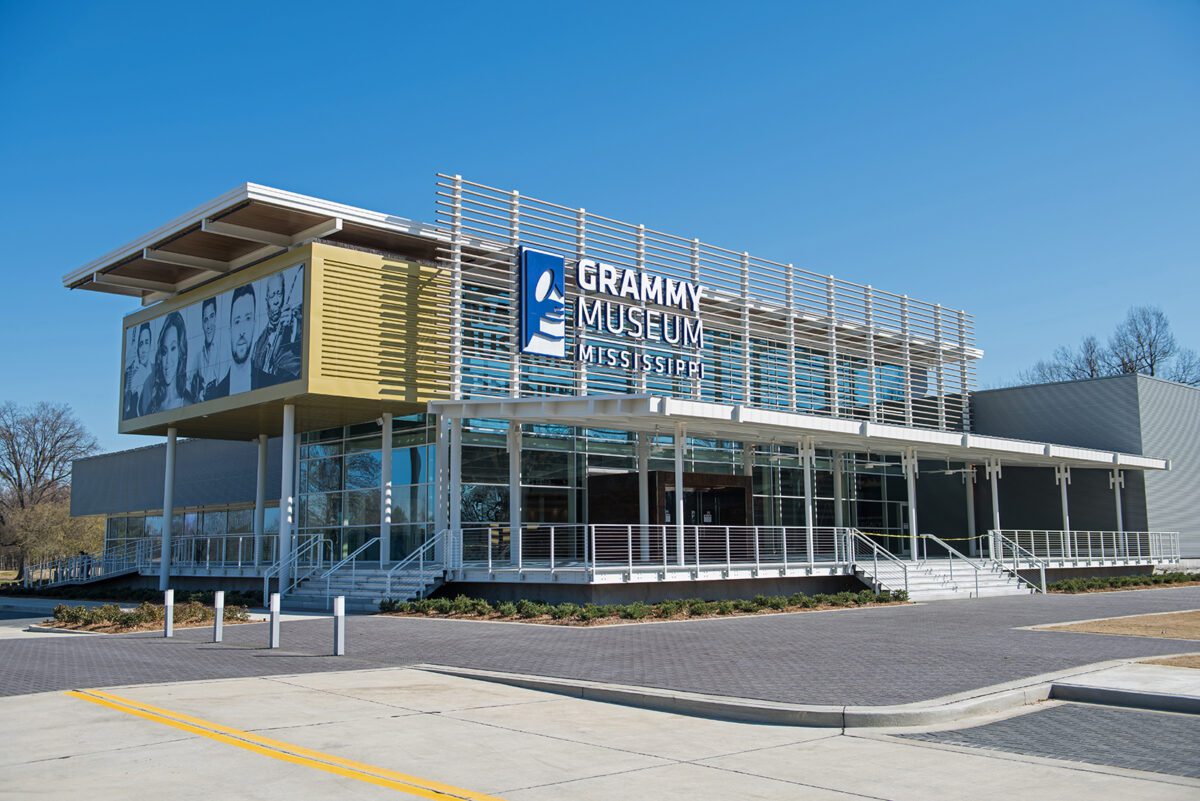
The design of the building gives a nod to the Delta itself, with its corrugated metal building inspired by the silos, barns and cotton gins that dot the Delta landscape. The wide, welcoming front porch, reminiscent of Delta country homes, invites visitors to “sit a spell.” Yet, the modern elements of the building, including wide expanses of windows along the front street exposure and a large, yellow-rimmed billboard-sized sign with the faces of music legends looking down on the side of the building, create a sense of excitement of what’s to be revealed inside.
“The GRAMMY Award is synonymous with musical excellence.” So reads the explanation on the wall inside the Cleveland museum. “Winners are not determined by sales, chart success or popularity. Rather, it is the result of a rigorous voting process carried out by music industry peers. GRAMMYs are awarded annually to musicians, producers, songwriters, recording engineers and other music professionals. To receive one is to be accorded the highest honor in the recording arts.”
Almost 10 years ago, the National Academy of Recording Arts & Sciences partnered with AEG, an international presenter of sports and entertainment, to create The GRAMMY Museum® in Los Angeles, a non-profit organization dedicated to cultivating a greater understanding of the history and significance of music. The opening of the 30,000-square-foot museum in L.A. coincided with the 50th anniversary of the GRAMMY Awards, the premier recognition of music accomplishments.
The roots of the American music celebrated annually at the GRAMMY Awards are planted deep in the fertile soil of Mississippi. It only seemed right that a spotlight be pointed on Mississippi’s musical legacy. Visionaries, including Allen Hammons of Greenwood, who helped establish the B.B. King Museum in Indianola, and Tricia Walker, a songwriter/musician and director of the Delta Music Institute at Delta State University, joined forces to form the Cleveland Music Foundation in 2011. Their first step towards a dream of having a GRAMMY Museum in Mississippi was to get permission from The Recording Academy to use the official GRAMMY brand. In less than five years, more than $12 million toward the $19.4 million project was raised by the state, the City of Cleveland and Bolivar County. The rest of the donations were given by private donors.
One of the board members of the Foundation was Emily Havens, an 18-year veteran of the Memphis-based Chickasaw Council of the Boy Scouts of America, where she served as field director. Pegged as the museum’s executive director, Emily transferred her passion for scouting to supervising the development of and coordinating the launch of the museum. Not only did Havens have the credentials for such a job, especially when it came to the all-important task of fundraising, she was also a Cleveland native. She already knew — and loved — the area.
“Did you know that eight percent of all GRAMMY Lifetime Achievement Award winners are natives of Mississippi?” she asked enthusiastically. “More GRAMMY winners (per capita) are from Mississippi than the next five states combined!”
Havens came on board as the executive director of the Museum in January 2015 and the museum opened in March 2016. She had to hit the ground running.
The museum’s designer was Washington, D.C.-based Gallagher and Associates, the same folks who designed the World War II Museum in New Orleans. The building’s architects were Jackson-based Dale Partners Architects in conjunction with Eley/Barkley of Cleveland.
A large, grand hall allows visitors to gather themselves before entering the museum. Along one wall are photos of the current GRAMMY winners that lead to the exhibit hall. Many of the exhibits are interactive, inviting visitors to learn to dance with a life-sized video screen, featuring artist Ne-Yo dancing to Michael Jackson’s “Billy Jean,” on a lighted dance floor. Around the corner, there are three separate enclosed spaces that take visitors through steps of writing, producing and recording a song with artist Keb’ Mo’. Special exhibits rotate through the museum every five to six months. Currently, the museum features a special exhibit of John Lee Hooker that includes singing along with his immortal song “Boom” that became a favorite of fans of NCIS New Orleans as the song was used for the opening credits of the show.
The Mississippi Music Bar and Timeline Trail explores the state’s musical history and culture. In the center of the room is a wide, blue interactive table designed by Michael Buday to simulate the Mississippi River. Imagine a raised pool with a current going down the middle. Artists and their GRAMMY-award winning songs are featured, along with a timeline that visitors can touch to see who influenced a particular artist and what GRAMMY artists they, in turn, inspired. For example, step up to B.B. King and slip on the headphones by his picture. You’ll hear a few bars from “The Thrill is Gone,” and you will learn that King was influenced by Robert Johnson and Muddy Waters. You will also learn that King had a huge musical impact on Eric Clapton, Bonnie Raitt and John Mayer.
In the Mono to Surround exhibit, visitors have an opportunity to hear how The Dave Matthews Band or Beyoncé’ would have sounded on a wax cylinder, the earliest recording device, as well as on a gramophone, vinyl record, cassette tape and today’s 5.1 surround sound, as well as on headphones. It is a very graphic depiction of how far the recording industry has come since its humble beginnings in the mid-1800s.
In addition to being a world-class museum, “the most technologically advanced museum in the South,” according to Havens, the GRAMMY Museum® serves as an important educational tool for children in Mississippi and nearby states.
She estimates that 75 to 80 percent of what happens at the museum is educational. Since its opening, more than 8,500 students have come through the museum, most on school trips during the week.
“I realized early on with my work on the board that this wasn’t just about tourism. We are changing kids’ lives with music, arts and creativity,” Havens said. “We are filling a critical gap in public schools that have declining arts programs.
“We have so many great workshops for kids, so schools tend to plan their trips to the Museum around our workshops.”
The proximity to the Delta Music Institute has provided opportunities for students there to get hands-on experience through internships and volunteer efforts.
“The partnership between the DMI Entertainment Industry program at Delta State and GRAMMY Museum® Mississippi is such a beneficial one for our students,” said DMI director Tricia Walker. “The museum calls on our students for support in various areas, including audio tech support, social media and event management. Our students also support the museum’s educational programs by providing student instructors for songwriting and music production workshops. These kinds of real-world learning opportunities are invaluable to our students and offer a way to help build their professional resumes.”
The Museum also provides internship opportunities for students from DMI, Delta State and other institutions of higher learning around the country, offering select students an extended professional training in the fields related to the music industry.
“We have actually hired two of our interns after they graduated,” said Havens, who expects that trend to continue. There are three enrollment periods for students to apply for internships each year.
“Having a global brand like GRAMMY Museum® Mississippi related to Delta State and the DMI program is very attractive to student prospects,” Walker said. “It’s all about educating future generations about the great legacy of Mississippi music and musicians and training the next generation of entertainment industry professionals in one of the most unique and authentic places in the United States.”
The Museum has been well-received and supported by citizens in Cleveland and around the state. There are many ways to support the Museum and its educational programs. Joining the Museum as a member is just one way to become engaged with the Museum and all it has to offer to the citizens of Mississippi.
“Cleveland is such a special place, and we are definitely providing a service for education, community events and in economic development. We feel we are helping Cleveland continue on an already successful path,” she said. “We have had 65,000 visitors since we opened in March 2016. They’ve come from 29 countries and all 50 states. I am always delighted to see visitors’ responses and excitement of how Mississippi has had such an impact on American music today.”
STORY Susan Marquez
PHOTOGRAPHY Rory Doyle
