

VICKSBURG, MS
Remembering a teen rebel who fought for her cause
Photographs by Old Court House Museum Archive
She was a teenage rebel with a cause, which resulted in her arrest and imprisonment, and her Yankee captors decided to make an example of her. Her name was Emma Kline, and her story happened 150 years ago. Her cause? The Confederacy.
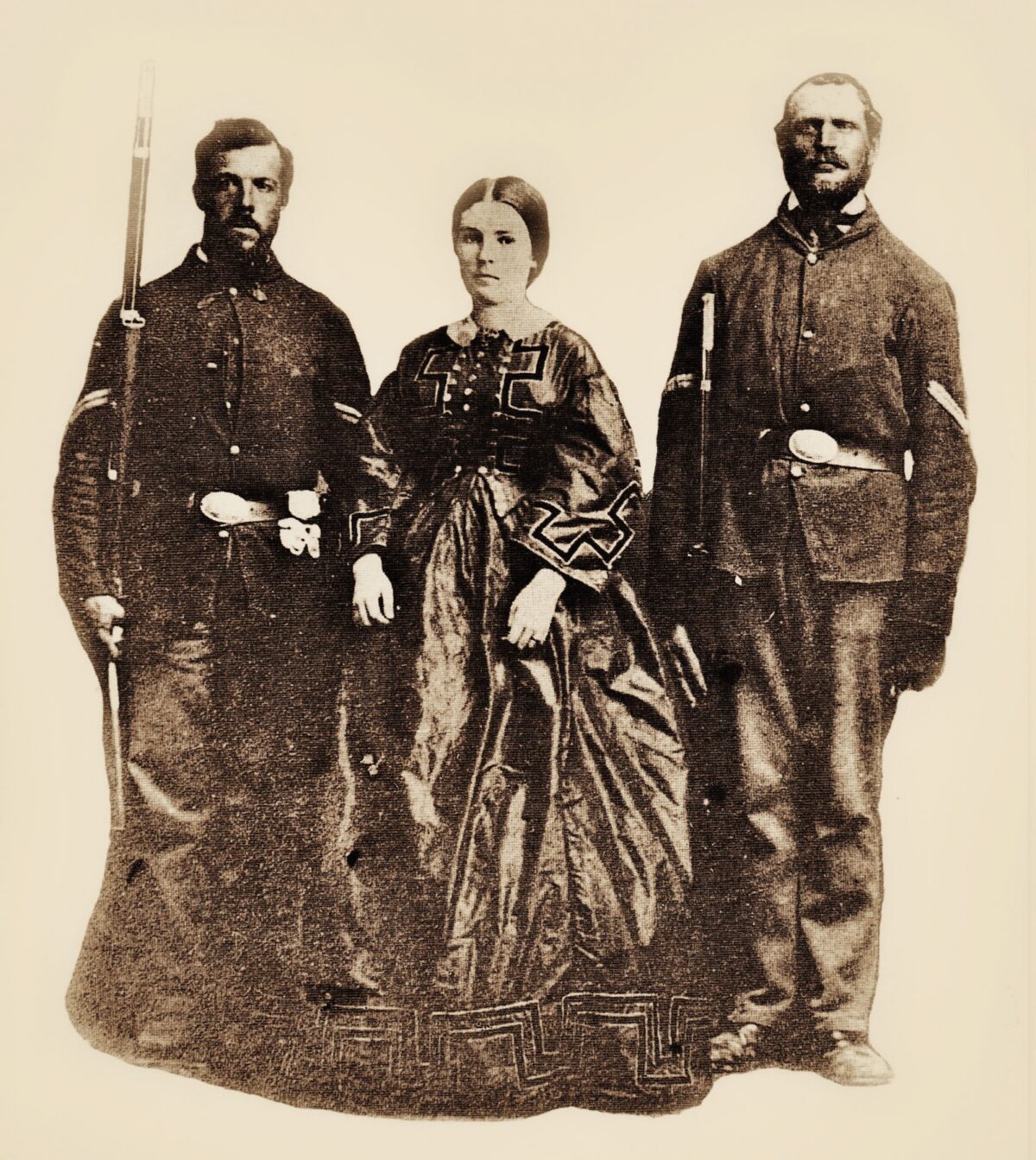
There was a photo in the archives of the museum at West Point Military Academy in New York, the voice on the phone told me. Did I know anything about it? The photo was of a Miss Emma Kline of Vicksburg, he said. It was taken during the Civil War, and two Union Army guards were holding her. The caller was Mike McAfee, curator of the West Point museum. His call was made about 15 years ago.
I could hardly believe it. Only a short time before I had read Thomas Kline’s account of his sister’s arrest, imprisonment and of being photographed for propaganda purposes. Mike graciously shared the photo with me. Had he called a few days earlier, well, I wouldn’t have known anything about it, and had he not called at all, I might have thought Thomas Kline’s story was just that, a good Southern tale about the Late Unpleasantness.
The timing was just right. There are no accidents in history.
Emma was 19 in 1864, the daughter of Nineon and Patience Lynch Kline, who lived on China Grove Plantation, about 11 miles from Vicksburg. Emma had an older sister, Annie, and brothers Nineon Jr., and Thomas. There might have been other siblings.
Thomas Kline recalled in an interview in the 1930s that he was about 8 years old when his father awakened him to hear the bombardment in Vicksburg in 1862. In the coming months, the war drew closer when Confederate troops camped in the Kline’s fields, but it was a year later, in the spring and summer of 1863, that the Kline children witnessed war and its aftermath firsthand. Never imagining that Vicksburg would become a besieged city, their parents sent them to town to live with their cousins, the Lums.
Ironically, the Lum home became headquarters for Gen. U.S. Grant, and it was probably because of the actions and attitudes of the Kline children.
According to Mrs. Grant, the general’s escort party was looking for a suitable house for his headquarters and for his family when “a belligerent young woman (a visitor, the family told me afterwards) imprudently made ugly faces at our handsome captain,” who, for spite, at once took possession of the fine home and spacious grounds.
Thomas described his sister Annie as “an ardent Rebel” who refused an introduction to Grant and forbade him to play with the general’s son, Freddie.
Both Annie and Emma came by their stubborn Southern pride honestly, for Gen. James B. McPherson, military commander of the occupied territory, suspected the entire Kline family of complicity with the Confederate guerillas, commanded by Capt. Isaac Whitaker and his Scouts, whose headquarters was on Regan’s Island not far from the Klines’ home.
Not only the Klines, but just about everyone else in the community was under surveillance, and McPherson told his staff: “There is a class of persons in that section who require watching. Although seemingly disposed to remain quietly at home and pursue their peaceful avocations, they are hostile in spirit…”
He didn’t mince words when it came to the Klines, for he thought them “guilty of acting in bad faith toward our government and imparting information to the enemy.” He singled out Emma, “especially Miss Kline.”
McPherson’s solution was to banish the family to what the Yankees called “Rebeldom,” lands in Hinds and Claiborne counties under Confederate control. The removal was to be immediate, and the Klines would not be allowed to return to Warren County without written permission “under penalty of being dealt with as spies.” They could take their personal clothing and household furniture; everything else would be confiscated by the United States government.
Thomas Kline told how the family was put on a raft with their belongings and towed across the Big Black where they lived with the Gibsons until the end of the war. Nineon Kline, too old for the regular army, joined Whitaker’s Scouts. When the Klines returned to China Grove nothing was left but the house and lands. Everything else had been stolen.
While the family was exiled, the daughters managed to go back to Warren County and smuggle items such as clothing to the Confederate army. It was during these forays that they were caught, along with their neighbors, Sue Nailer and Lucy Highlender. The arrests were in May and October 1864. How long they were incarcerated isn’t known, but their names appear in the records of the Provost Marshal, which are among the holdings of the Old Court House Museum.
There was more to the story: Emma Kline was photographed, a prisoner between two Yankee guards from the 5th Iowa Infantry. The picture was circulated as a warning, a bit of war propaganda, of what would happen to Southern girls who aided and abetted the Confederate cause.
After the war, Annie moved to California, where she gained fame and fortune as a lady gold miner. The remainder of the family continued to live at China Grove.
The year 1878 was one of joy and sorrow. On Jan. 31, Emma married William Lum Lane, a descendant of the founder of Vicksburg. Tragedy came in late summer when the worst Yellow Fever epidemic in the state’s history devastated many households in Warren County with more than 1,000 deaths recorded.
There were few families the scourge did not touch. The first of the Klines to die was Emma’s mother, Patience.
She died on Oct. 10 and was hastily buried that night at Asbury Cemetery “without the procession of friends,” Mrs. Sophie Goodrum, her neighbor, wrote in her diary. Two days later, Mrs. Goodrum penned another tragic entry: Nineon Kline Jr., had died, and she wrote “Poor Fellow. Just been married nine months. None are spared.” There were other deaths with many of the burials at Asbury.
The first frost usually brought an end to Yellow Fever epidemics, but the effects were often felt long afterward. Two days before Christmas in 1878, Emma Kline Lane died, her health thought to have been broken by the terrible scourge.
Emma’s wedding had taken place only 11 months earlier in the Klines’ parlor. Now, on Christmas Day, her body lay in a casket in that same parlor, dressed in the same wedding dress, a request she had made shortly before her death. It was a miserably cold day with sleet and snow falling as she was laid to rest beside the still fresh grave of her mother.
Until recently, no stone marked the grave of Emma Kline Lane, but now a monument reminds those who visit Asbury Cemetery of the teenage rebel who risked all for a cause she held dear 150 years ago.
STORY Gordon Cotton
PHOTOGRAPH Old Court House Museum Archive
