

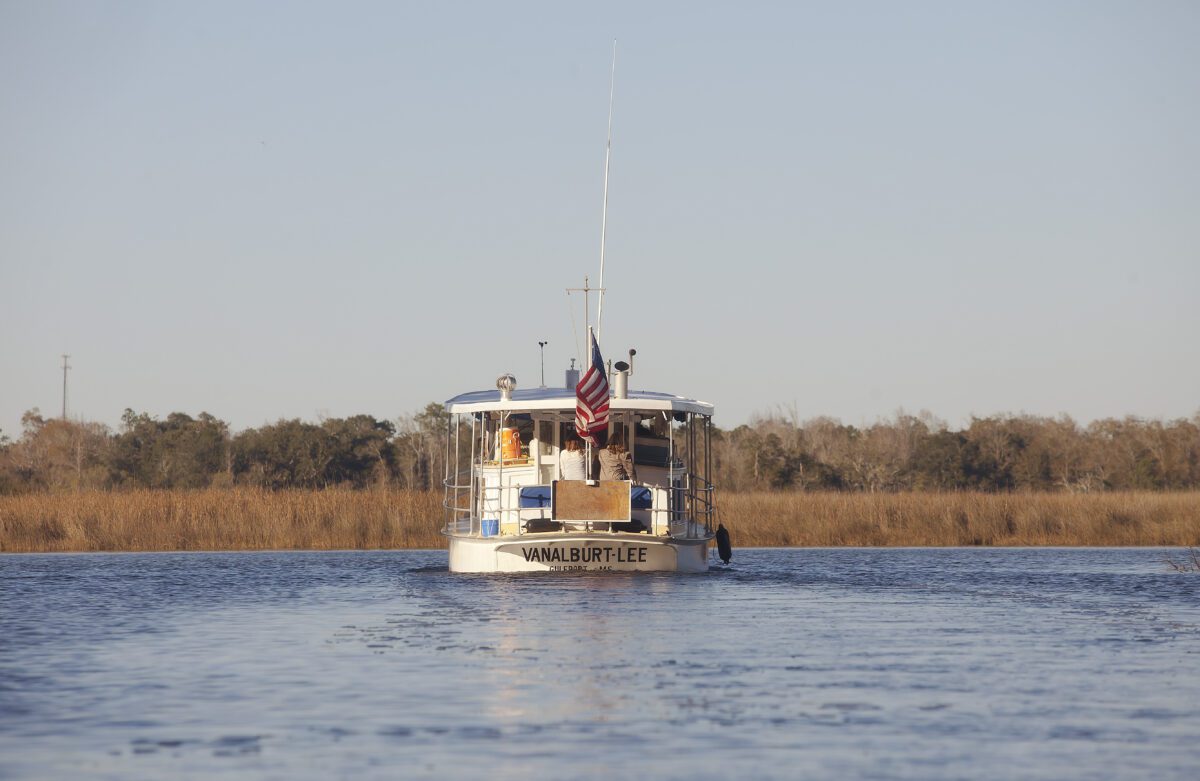
Harry Hewes can remember, as a 5-year-old, the uneasy feeling he had walking to the end of the pier to first set eyes on the wooden boat his father would purchase and cherish for the rest of his life. That was the first of many memories Harry would have of the family treasure that has become a marvel of the Gulfport Harbor.
Photographs by Melanie Thortis
Gulfport – “I was scared to death going out on that pier because it had cracks between the planks, and I thought I was going to fall between them,” said Harry, now 76.
On that day in 1944, The Vanalburt-Lee, a 46-foot lugger, became the sister the Hewes brothers — Harry, Clint and Tommy — never had. Dr. Archibald Hewes, with his oldest son in tow, purchased the then-20-year-old boat from a doctor in Biloxi. It was the same day his wife, Vivian, was giving birth to his third son, Tommy.
“I’ve always been told that Daddy bought the boat the year I was born, and Mama claimed that she was in the hospital having me when he bought the boat,” said Tommy, the undisputed captain of the prized motor vessel. “And she claims that, on the way home from the hospital, he drove down there to Biloxi to show her the boat. The way she told it, Daddy (already) had two boys, and when he had me, he was so disgusted that he went out and bought the boat. And the boat was his girl.”
“With every baby boy that was born, according to your mom, he would tell her, ‘Take down the rosettes and put up a sail,’” Marian said to her husband.
Built by a naval architect in 1924, the boat is named for the original owner’s best friends — Van, Al, Burt and Lee. And, much like the name, little has changed since the boat first entered the water with its prideful first owner.
“I can remember when we bought it, the doctor was so proud of that boat, he wouldn’t totally close the deal until he made sure that my daddy and my uncle, who were partners at that time, could handle the boat and would take care of it,” Harry said. “So, it stayed for a period of time on his pier under Biloxi.”
Perhaps no other owner could have cared more for that boat than Archie Hewes, a man who, although a bit difficult to describe, clearly had boating and fishing in his blood.
“There’s no nutshell,” Marian said, describing her late father-in-law.
A graduate of Ole Miss and Vanderbilt medical school, Archie was raised just one generation from the Civil War. He grew up listening to stories of his great-uncle fighting in that war and decided he, at 17, would enlist in World War I and join the field artillery. Luckily, Tommy said, he was caught for lying about his age. Later, Archie joined the Army, but he was discharged because of a retinal hemorrhage before he could be sent to war, Harry said.
Archie spent his career as a general surgeon, the second board-certified in Mississippi. But, every minute of his free time was spent on the Vanalburt-Lee.
“I don’t know how he got through medical school, because his true love was fishing,” Tommy said.
Even when the doctor was on call, he left his wife by the phone so he could spend time working on the boat.
“Back then, they didn’t have beepers and things, and when Daddy was on call, he also spent the whole weekend down there piddling on it here in the harbor, and Mama had to sit home by the telephone,” Tommy said. “If he got a call, she had to drive down to the boat and get him to bring him back. She was on call the weekends that he was.”
And, when they weren’t on call, they were on the water.
“Archie and Vivian went out on the boat — not most weekends when he wasn’t on call — but every single weekend that he wasn’t on call,” Marian recalled.
Vivian would make pimento cheese sandwiches and pack them in a shoebox. But, as long as she was on the boat, her husband did all the work. “
He never lifted a finger at home. But, when he was on the boat, she was a queen,” Tommy said. “He did all the cooking, all the everything.”
For the Hewes boys, though, the same royal treatment didn’t apply. For them, being on the boat with their father meant hard work.
“Daddy was one of those people, it was ‘Yes, sir. No, sir’ and you had to be on your toes,” Tommy said. “He gave you a quiz at every meal on the boat about safety or navigation or something, so it wasn’t too pleasurable at that point.”
A lifetime spent on the Vanalburt-Lee — annual family vacations to Destin/Fort Walton, hunting for Christmas oysters on Cat Island, weekend voyages to Ship Island and the legendary annual June Trip — did, over time, make the brothers appreciate the uniqueness of the family vessel.
Designed for the shallow, choppy water of the Mississippi Sound, the Vanalburt-Lee is technically a lugger, but it was built more like the yachts of its time.
“That’s the difference between that and all the other ones around here. The Biloxi boat builders learned their trade from their fathers and grandfathers,” Tommy said. “This boat — (the builder) was a Naval architect first, so he drew blueprints and all that, and the design of the hull is just totally different from the regular Biloxi luggers.”
The boat is made out of cypress with mostly original chrome-plated brass fixtures. The cypress deck planks are covered in canvas to prevent leakage. It features a walk-around deck and is shaded with a canopy, the only part of the entire boat made of fiberglass.
Even though its age alone — the boat turns 91 this year — makes it a standout watercraft, it also has unique elements — most were added in the early 1950s — that give it additional bragging rights.
“When my dad had it, two of his best friends were with Kennedy Marine in Biloxi. They were good mechanics, also,” Harry said. “You didn’t see any yachts back then with automatic pilot steering and with electrical anchor wenches that pulled up the anchor. These people took materials off these old World War II boats and built those things for my dad on the boat. Back in those days, we had that luxury.”
And, all of those bells and whistles that make the Vanalburt-Lee a rare breed still work today, including the current engine, a World War II transport ship surplus that was installed around 1949.
“After the war, those Kennedys bought a bunch of these engines and put them in all the shrimp boats and revolutionized the shrimping industry. So, they put one in this boat and it still runs perfectly,” Tommy said.
Tommy added a diesel generator but kept the 32-volt battery system commonly used on commercial boats in the 1940s and ’50s.
“We added a generator, and it’s like a submarine now. You run the generator to charge the battery, so when we go fishing, we get off in the morning and fish in little boats out there and run the generator while we’re gone so we don’t have to listen to the noise,” he said. “Then when we get back everything’s on battery like a submarine, and it’s quiet.”
While a few improvements have been made, including the rebuilding of the hull about 25 years ago, the boat still doesn’t have the more modern luxuries often found on today’s boats.
“Generally when someone obtains an older lugger, they will fiberglass it. They’ll upgrade the interior,” Marian said. “Oh, they always put in air conditioning, showers, big screen televisions, which we don’t have — any of the above.”
And, that’s the way it will remain, according to Tommy, who, since his father’s death in 1978, has maintained the boat along with its legacy. Except for some refinishing he did to the interior, he intends to keep it the same as it was when his father was at the wheel — right down to the cast iron skillets that are as old as the boat. He will also never add a shower or air conditioning.
“Daddy had a saying: ‘You got to be miserable to catch fish.’ You put an air conditioner on here, people would be sitting in the air conditioning. Nobody would be out fishing,” he said.
Every year, Tommy, a retired orthopedic surgeon, coordinates the June Trip, which his father started even before he bought the Vanalburt-Lee. On the seventh of June, seven men embarked on a seven-day journey full of fishing and camaraderie. The trip, now in its 75th year, sticks to the same rules from his father’s day — except the trip duration.
“Modern wives won’t let their husbands go away for a week,” he said. “In Daddy’s day, the wives couldn’t wait for them to go away for a week.”
They still, after a week of catching, cleaning and eating fish and bathing in the Gulf waters, wrap up the trip with a banquet on the last night complete with a beef dish similar to the one their father prepared every year.
The tales from those June Trips and any voyages on the Vanalburt-Lee, for that matter, are iconic. People across the Coast clamor to catch a glimpse of the inside of the legendary boat and join the hundreds who have added their names to the Vanalburt-Lee logs, which date to the 1950s.
To add to its legendary status, famous food critic Craig Claiborne wrote about the boat in the New York Times in 1967. The article is framed inside the cabin near a framed copy of a poem written especially for the boat by Russell C. Davis, the former Jackson mayor for whom the Davis Planetarium in the state’s capital is named.
Archie died a month after his 1978 June Trip and, the torch was passed to the Hewes brothers. It was up to them to keep the Vanalburt-Lee proudly sailing.
“From then on, it was in my hands. That was all my spare time from then on. The rest of my life was taking care of that boat,” Tommy said light-heartedly. “I had picked out a beautiful sailboat — a Bermuda 40 — that I was going to buy just as soon as I could. And, then I got left with this and that was the end of that.”
Ownership was split three ways until the middle brother, Clint, a retired pathologist who lives in Philadelphia, Pa., gave his interest to Tommy. And, although Harry, a retired attorney, was raising his five children while Tommy maintained the boat, he kept his share.
“I sent kids to college while Tommy was keeping up the boat,” he said. “Tommy wouldn’t let me give up my one-third interest. He goes on trips and things and, whenever I come, I have to take the boat around and tie it up.”
The Vanalburt-Lee continues to play an important role for the Hewes family. As soon as the weather warms, it is on the water with some of Harry’s children and grandchildren and their friends basking in the sun, drinking “Uncle Tommy’s” famous Cuban daiquiris and playing in the chicken coop on top of the boat. The coop, originally used to store live chickens on long journeys when refrigeration was sub-par, is now screened-in and “a giant playpen” for Harry and Marian’s grandchildren, as well as a favorite sleeping spot on longer family outings.
“We all just sit around and visit. Something about being on the water — I’ve never been the slightest bit outdoorsy — just makes me feel calm and at-ease,” said Harry’s daughter, Hallie Hewes Collins. “Just coming out and looking for dolphins and the pelicans and hanging out. My generation was spoiled because Uncle Tommy always cared for the boat. For us, the boat is just a good time.”
Even though the Vanalburt-Lee doesn’t shine like some of the other boats in the Gulfport harbor, its history and significance make it a prize vessel for those connected to it.
“The boat from the outside — there’s nothing very spiffy about it,” Harry said. “But, if you’re a Marine architect, you can look at it and say, ‘It’s beautifully designed.’ It would take that type of person.”
The Vanalburt-Lee has made appearances at several boat shows, including the Madisonville Wooden Boat Festival in Louisiana, and, while it certainly stands out, it rarely comes away a winner.
“It’s not a boat-show kind of boat. It doesn’t shine, and the judges — they kind of throw up their hands,” said Tommy. “They’ve never seen anything like it, because it’s just not a boat-show kind of thing. When we took it to the boat show in Biloxi, it was the year the boat turned 75. They created a special category just for it. They made it the overall winner of the boat show rather than try to put it in a class or anything, because it is in a little different class by itself.”
Its uniqueness is certainly a large part of everyone’s infatuation with the Vanalburt-Lee. No one, of course, was more enchanted by it than Archie.
“You read stories about people who really get attached to their boats,” Tommy said. In the Maritime and Seafood Industry Museum in Biloxi “they’ve got a boat (that belonged to) a very famous man from New Orleans. He had an affair with his boat. That was his life, and it was the same thing with Daddy. It was his daughter — his baby girl.”
Even when Hurricane Camille threatened the Gulf Coast in 1969, protecting his “baby girl” was first priority for Archie.
“When Camille came, it gutted the first floor of our house, and Mama complained,” Tommy said. “She said, ‘Archie spent all day long getting that boat ready for that hurricane and he didn’t do a damn thing at my house, and, look, I’ve lost everything downstairs.’ And that’s the way it was. That (boat) was No. 1.”
For Tommy, caring for the Vanalburt-Lee is a bit different. Marian refers to it as a “treasured onus” for him.
“Now, it’s an old, sick grandmother. You love her, but you hate her,” Tommy said, laughing.
His mixed feelings rely on the fact that no one other than Tommy and a few close friends can make needed repairs.
“The boat is so old and unique, I couldn’t call a mechanic to go down there and fix it,” he said. “They wouldn’t know where to begin. We’ve always done the upkeep ourselves. This generation — they couldn’t begin to know how to manage all that — it’s just the way it is.”
Harry said he’d like for H, his only son, to eventually learn how to operate the boat and take it into the next generation.
“Tommy is the mechanic on there and, because he was involved in the rebuilding, he knows how everything is wired,” Harry said. “Anybody that’s on the boat — particularly a wooden boat — will tell you that it’s a full time job. My son, H, can operate it but he doesn’t know all the intricacies. He hasn’t been able to spend enough time with it. I just hope he’ll be able to take it over and keep it up.”
Tommy has no future planned for the boat that has been his inherited hobby for the past 37 years.
“My philosophy is, ‘I can’t worry about it.’ I’ll be gone,” he said.
So, the worrying has been passed down to the next generation, Harry’s children, who treasure the boat and want to continue its legacy.
“It’s my job to worry,” said 36-year-old Hallie, laughing. “I don’t know what to do about it, so I just worry.”
For now, Tommy still sips from the captain’s cup Hallie made him years ago, and he will keep his father’s prized possession tip-top as long as he’s able.
About 15 years ago, he purchased a piece of land he calls Hurricane Hole, which is where The Vanalburt-Lee rides out storms and hurricanes. The land is just off Wolf River in Pass Christian, about 15 miles by car from the Gulfport Yacht Club where the boat is kept outside of inclement weather. The boat was docked at Hurricane Hole when Hurricane Katrina wiped out both of the Hewes family homes. The Vanalburt-Lee suffered only minor damage.
“I remember when we were in Oxford right immediately after Katrina, and we had lost Uncle Tommy’s home, which was my Uncle Goat’s house — it was a family home — and we had lost our home, which was my grandparents’ home,” Hallie said. “And, we were definitely still reeling. When we finally got word that the boat made it, it felt like, “Yea! There’s a piece of us that’s still around. And, that felt really good.”
At a time when the Hewes family felt like they had lost everything, the Vanalburt-Lee stood as a symbol of home, a sentiment Hallie had already begun to grasp years before the storm.
“I wrote a paper about it in college. I was sitting on the boat and where I was, I could practically see everything that I considered home,” she said. “I was on the boat, which was home. I could see our house and, then, the yacht club across the harbor, which is another kind of home for us.”
Thirty-year-old H, the youngest of Harry’s children, said the Vanalburt-Lee will always be a special place for his family.
“It’s not an experience you can re-create anywhere else,” he said. “It’s something that’s kind of sacred to us, and our whole family has used it as a means to get closer and spend time with everybody.”
Almost four generations after the Vanalburt-Lee entered the Hewes family, each voyage seems to tie them back to Archie, its ever-faithful former owner.
“He died right before I was born, but I always felt like — to me — the boat is how I know him,” Hallie said.
And she and her siblings hope to continue the legacy.
“It’s something that I won’t ever take for granted, so I try to soak every bit up,” H said. “I can tell you that everybody I’ve ever known begs to go out on the Vanalburt-Lee, and I look forward to taking people out in the future and showing them a good time on it.”
STORY Lauchlin Fields
PHOTOGRAPHY Melanie Thortis
