

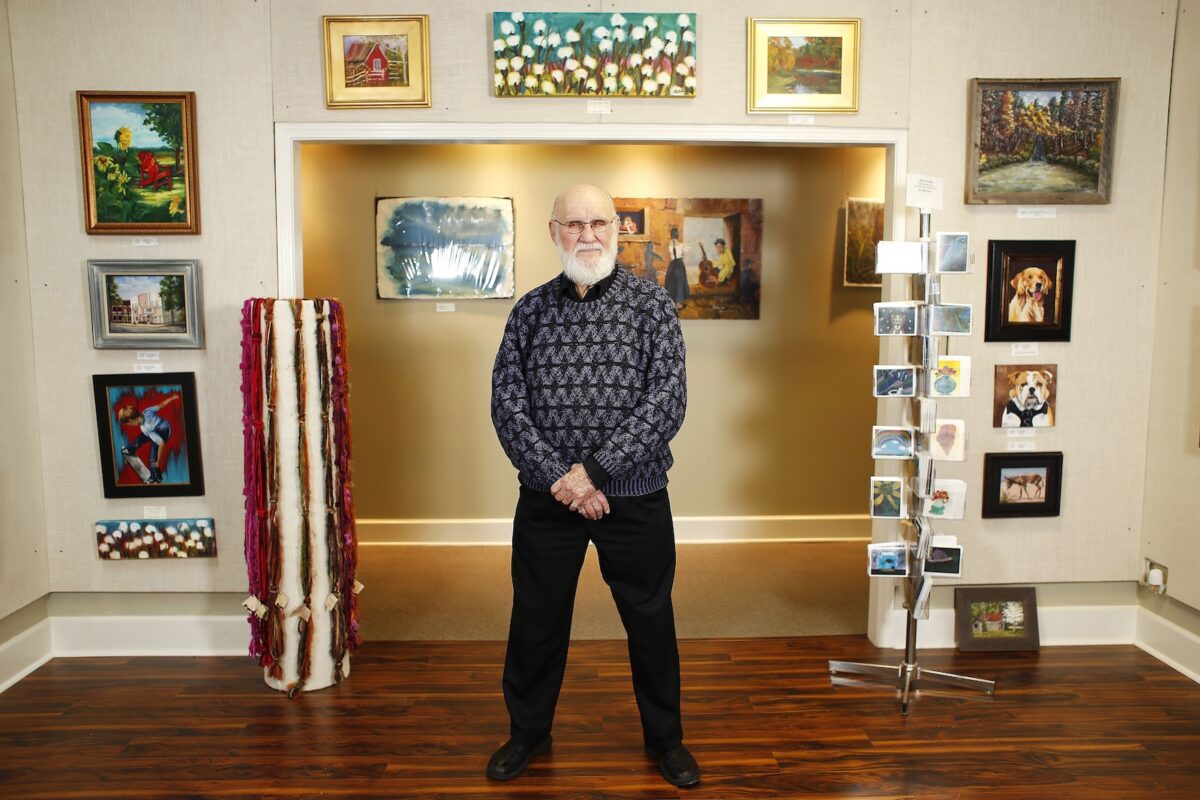
Octogenarian Artist
'An old man with a little boy name' remains passionate about design
Photographs by Lauren Wood
Sonny Boatman has always had a flair for design and a love of designing. But he’s not sure of its roots. “It’s hard to put your finger on it,” said the 84-year-old artist. “Whether it has to do with the array of objects on a shelf or in a case or furniture in a room, I always seemed to have a sixth sense about how to make these things work together. And I have always received a personal satisfaction in accomplishing that.”
Born in west Corinth, in Alcorn County, just miles from the Mississippi/Tennessee border, Sonny’s name was a point of family discussion. Two aunts suggested names, but no one could make a decision. “So I was Sonny Boy Boatman for a while, and later James Everett Boatman. I was called Sonny by friends, James at school, and my grown-up name became Jim, but later I realized what I could recapture of my youth was my name — Sonny. I’m an old man with a little boy name.”
Sonny was drawn to the arts even as a child. During his first few years at West Corinth Elementary School, his favorite class was Expression, which intertwined music and expression.
He attended The Memphis Academy of Art, now the Memphis College of Art, after high school. His first year there was filled with a broad spectrum — basic design, pottery, painting, drawing. These things would be the focus of his arts education until time came for him to concentrate on his major — interior design.
But it was 1950, & the United States was involved in the Korean War, and as a joke Sonny and his roommate announced to a friend that they’d joined the Air Force.
Basic training in Texas and some time in Selma, Ala., paved the way for young Sonny to be sent to Tokyo, where he spent two and a half years.
“I had an office job working as a draftsman, making charts showing how many missions we’d done in Korea. It was top secret stuff,” he said.
But at night, Sonny’s thoughts returned to art, and he signed up for night classes, taking art history. He sought a class in Japanese painting, and his search led him to artist Kazue “Baye” Mizumura, who taught traditional Japanese sumi-e ink drawing.
“There were three of us who went by train to her house for lessons,” Sonny said.
“She gave us a huge party,” Sonny said, still laughing decades later. “We felt so badly, we had to go join up. We were about to be drafted anyway.”
The Mississippi and Japanese artists became friends and remained so until Mizumura’s death.
After his time serving his country, Sonny returned to Memphis and worked for Lowenstein’s Department Store in display. Then, thanks to the G.I. Bill, he continued his art education at the Academy of Art. After three years at the Academy, Sonny traveled to Mexico City and enrolled for a final year of college at Mexico City College, where he studied Spanish, anthropology and Mexican Early Art.
From Mexico back to Memphis, Sonny worked with a decorator, but took a week’s vacation to visit New York City and became convinced by friends it was the place to be because of all the “fun and opportunities.”
“With the promise of an interview — not a job — at Lord & Taylor, I went home to resign my job,” Sonny said. “If you are young and foolish, that’s enough, I suppose.”
So with a few belongings and the promise of an interview, Sonny boarded a Greyhound bus and headed east to the Big Apple. The Lord & Taylor interview brought the offer of a job as a beginning staff person, but Sonny was not impressed.
“I thought with all my experience from Lowenstein’s in Memphis, they could do much better,” he said, laughing at the arrogance of youth. “I turned down the job and started looking for others, but there were none to be found, so I called back to see if the job at Lord & Taylor’s was still available. I figured I could work there temporarily until I found something better.”
Temporary turned into nearly 20 years, which, Sonny said, was a learning experience and a joy.
It was 1960 and Lord & Taylor was one of the premiere department stores in New York. Sonny started as an assistant to a man named Tom McNeese who hailed from south Mississippi — cue “It’s a Small World.”
“He was in charge of two designer floors — sportswear on fifth floor and couture on third,” Sonny said. “After about a year, Tom quit and I was given his responsibility and an assistant. And three years later, the assistant to the director of display resigned and I became assistant director of display for the interior of the store.”
And, as if leading a charmed life at Lord & Taylor, Sonny eventually replaced the director of display. At Lord & Taylor, Sonny worked long hours, but the job was not without its fun moments.
“We’d be in our office and we’d get a phone call from someone out in the store with an alert: ‘Garbo’s in the fabric department’ or ‘Dietrich is on the seventh floor’ or ‘Kate Smith is on the main floor.’ We’d rush to whatever floor and try to pretend we were shopping just to catch a glimpse of these famous people.”
Sonny’s designing skills did not keep him confined to the store’s Fifth Avenue building. He was tasked with putting together multiple suburban stores for Lord & Taylor openings in Chicago, Philadelphia, Boston and Washington, D.C. And, in advance of a planned Florentine promotion at the New York store, Sonny was sent for a week to Florence, Italy, where he visited art museums and borrowed reproductions of famous works to use in the windows and on the floors of the New York store.
“A reproduction of Michelangelo’s ‘David’ was one foot shy of hitting the ceiling back in New York,” Sonny said. “The Florentine event six to eight months later in the store was well publicized and successful. That was a very exciting assignment.”
Another store promotion completed by Sonny and his staff was a salute to all museums in the NYC area. Sonny was assigned to go to all the museums and talk with people about loaning reproductions to Lord & Taylor.
“I found a much-hidden Tibetan museum that loaned us real pieces for the store promotion,” he said.
As if Sonny were not busy enough at Lord & Taylor, he did some freelance business on the side.
“I set up the wholesale showroom for Wear-Right Gloves, where they had as many colors of gloves as in the color wheel,” Sonny said. “I also did some work for Brownstone Studio, a catalog house that sold mainly to folks — not skinny models — and for Glentex scarves. They opened a shop a few blocks from Lord & Taylor. I could run over during lunch to work and also work on weekends and evenings.”
While at Lord & Taylor, Sonny found time to start his own small art gallery on Bleecker Street in Greenwich Village. “Sonny Gallery was open evenings and weekends,” he said. “I had the gallery for several years until other job responsibilities took up more of my time. One of the first artists whose work was shown in the gallery was from Memphis.”
After nearly 20 years with Lord & Taylor and a decade more in New York, Sonny began thinking of a place to retire.
“I looked around New Jersey and other places near New York, and all the towns I was attracted to reminded me of Corinth,” he said. “So, I decided that’s where I should go.”
Sonny returned to his hometown in 1992 and soon was asked to help with set design for a production at Corinth Theatre-Arts. He’d had some experience a few decades earlier at Front Street Theatre in Memphis. He has served on the CT-A board several times. Because of his interest in historic preservation — he’d bought and refurbished a brownstone in Brooklyn — he became a part of the Preservation Commission in Corinth, where he served at least eight years. And he’s served on the board at the Verandah-Curlee House and Museum, putting to work his passion for preservation, history and architecture.
He helped establish the Heritage Festival in Corinth 13 years ago and hopes to re-establish it — “if I can find a young person to take it on.” With his snow white beard and crystal clear blue eyes, Sonny’s a dead ringer for St. Nicholas and dresses the part each holiday season for photographs with people’s pets, all to benefit the local animal shelter. It’s no surprise he was recently named Corinth’s Citizen of the Year.
And, don’t forget about art.
Retirement has not dulled Sonny’s sense of style. More than a decade ago, he helped start a co-op gallery in Corinth that today, with a revamped mission statement, operates with the help of volunteers as Corinth Artist Guild Gallery. Sonny, as guild president and founding member, has used his design skills to arrange the art in the gallery’s newest building at 609 Fillmore St.
Looking back over his years in New York and his just-as-busy retirement years in Corinth, Sonny seems a bit overwhelmed.
“I can’t believe how quickly it all happened,” he said. “I made a living doing what I love. And after retirement, I thought I might do something different, but it’s just a part of me. There are favorite activities I just feel compelled to continue in some form.”
“We’re here to create an appreciation for art.”
“My energy comes from interest in what I’m doing. I didn’t come home to sit in a rocker on the front porch. I keep going because I keep going. All these things give me a good reason to get up in the mornings.”
Sonny Boatman
STORY Leslie Criss
PHOTOGRAPHY Lauren Wood
