

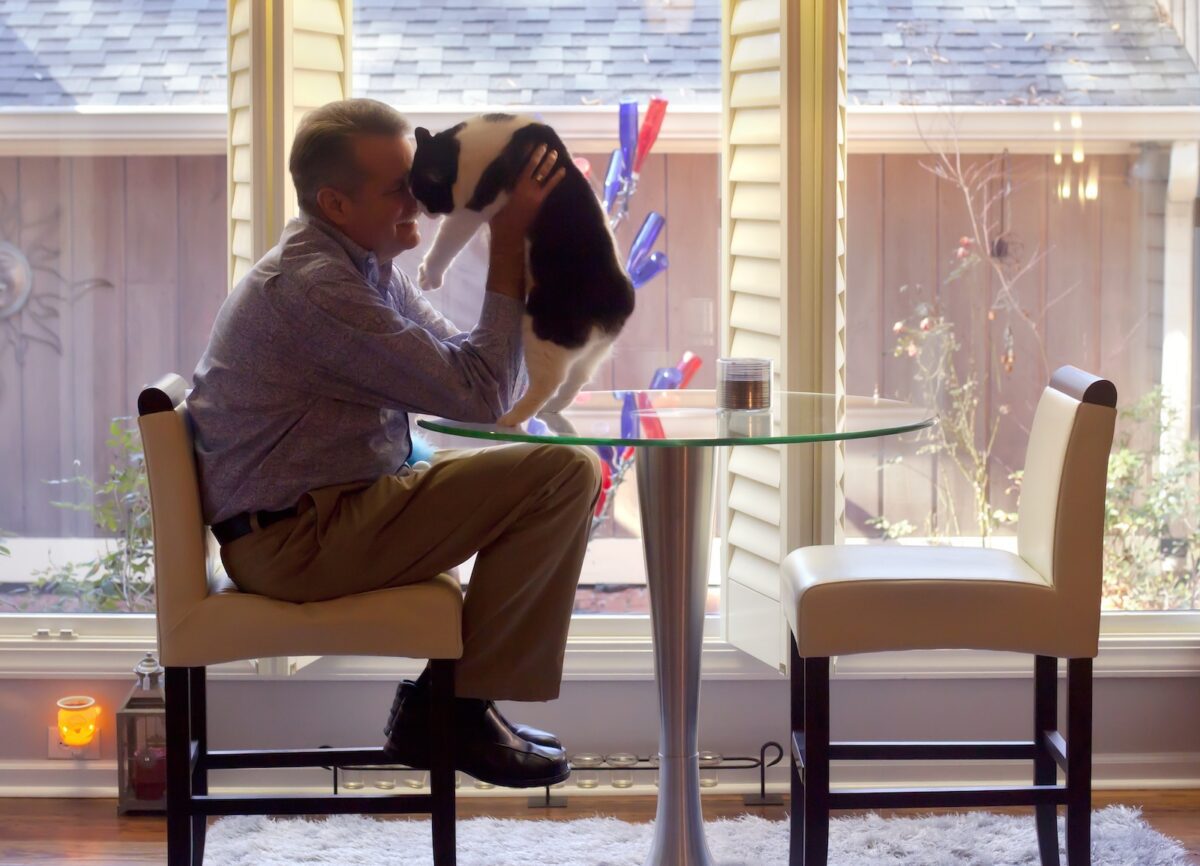
Robby Whyte has met thousands of cats in the last 30 of his 50 years. He’s never met one he didn’t like.
Robby is a cat show judge, a role that has taken him to 45 of the 50 states and to England, Italy, Switzerland and four times to France.
He grew up in Jackson, where he still lives. His parents didn’t like cats, he said, but, “I’ve always liked cats — since I was a little kid.” He was never allowed to have one inside, but he always had one “or two or three or however many I could hide in the garage.”
A neighbor, Miss Susie Cooley, “an elderly old-maid school teacher-type in her 80s” bred Persians, and Robby would go visit her just to play with the cats. He loved Persians, but his parents were adamant — no cat in the house.
“I said the first thing I’m going to do when I have my own place is have a purebred cat,” and he kept his promise to himself. When he was 20, he rented an apartment, “And the day I moved in was when I went and picked out my first purebred Persian, named Gizmo.” He came from Miss Cooley’s cats. 10 That was also about the time he became active in cat shows, entering his own — Gizmo was a regional winner — “and from there it was just kind of…..” What might be termed a hobby became almost a passion. He showed cats for about 15 years before he began judging.
It isn’t as simple as just wanting to be a judge. Robby is a member of TICA, The International Cat Association, which sponsors hundreds of shows and has stringent rules and regulations for one to become a judge. For several years, an aspiring judge must prove himself by serving as a show clerk, putting on shows and fulfilling numerous other requirements.
TICA is the largest cat registry in the United States. Another group is the Cat Fanciers Association, and there’s a local organization, the Mississippi Cat Fanciers. The latter has been around for about 40 years and has sponsored shows in Jackson, Meridian, Natchez and Vicksburg.
There isn’t a weekend on the calendar where there isn’t a cat show; often seven or eight are scattered around the country, and each often attracts about 200 entries. There are usually 12 judges, six each day, who judge each cat in the show in alphabetical order, starting with Abyssinians. The best of each breed is chosen for the finals.
The judges use a written standard based on a 100-point scale. There are so many points toward the head, the body, coat, pattern, etc. Of the 63 recognized breeds — 12 more are in the works — the felines are divided into kittens, purebreds, altered, the domestic short-hair and long-hair, and there’s also a place for the common household cat (but don’t tell them they’re common).
The shows are held in large convention-type areas with the cats in numbered cages. After visiting the cages, the judges call the numbers of the cats they want to see up close, usually 10 to 12, and they are arranged in a U-shaped area. There’s a table and a scratching post, and each cat is taken out of its cage to be examined.
“We show the cats to spectators and talk about the cats,” Robby said. “Tons of pictures are taken.”
Shows have themes, from casual to very formal, and, in Europe, the shows, which are usually much larger than those in America, often include ritzy, black-tie banquets. It isn’t just the judges who dress up — many cats wear fancy collars and costumes for special occasions or holidays.
Sometimes, Robby said, the competition can be cut-throat.
A black and white Persian from the United Kingdom named “License to Kill” is currently the “top cat,” the highest-scoring cat in history. It has been to the United States, and Robby has judged several shows in England where this cat was featured. He refers to License to Kill as “the most beautiful I’ve ever seen.”
The most popular cats are the Maine Coon and the Bengal, but it used to be that half of each show was made up of Persians. There are also the oddities, such as the hairless or Sphinx, which really isn’t hairless, but its hair is so short that its coat feels like suede.
Robby has had 10 to 15 show cats, including four international winners, and twice he has been named the Southern Judge of the Year. He’s been to about 400 cat shows and has never been bitten.
Cats are as individual as their owners and have certain peculiarities. The purebreds, he said, “are real laid-back, more like an ornament, kind of like an accessory.”
Tri-color males are usually sterile, and white cats with blue eyes are usually deaf and often an odd-eyed cat (one blue, one another color) will be deaf in the ear with the blue eye “or so they say. I don’t know how they tested them to find out.” Sometimes, Robby said, he goes to an animal shelter or the Humane Society and sees a cat “that just breaks your heart” and you can’t leave it. Such organizations and TICA stress the importance of spaying and neutering. Also stressed is selective breeding, “and most breeders are also selective in who the kitten goes to.”
Robby could be a show judge every weekend if he chose, but it’s costly. Robby is a nurse or, otherwise, as a cat show judge, “I would possibly make a living just below the poverty line.”
He doesn’t know how many cats he has owned — “a good many” — and once had 10. Now, he has one, a black and white well-fed Manx named Sam, who does what most cats do — sleep, play, eat and pitter-patter around the house, then sleep some more. Perhaps it began with Gizmo 30 years ago, for Robby said, “The Persians will always be my favorite, always be my love.”
STORY Gordon Cotton
PHOTOGRAPHY Melanie Thortis
