

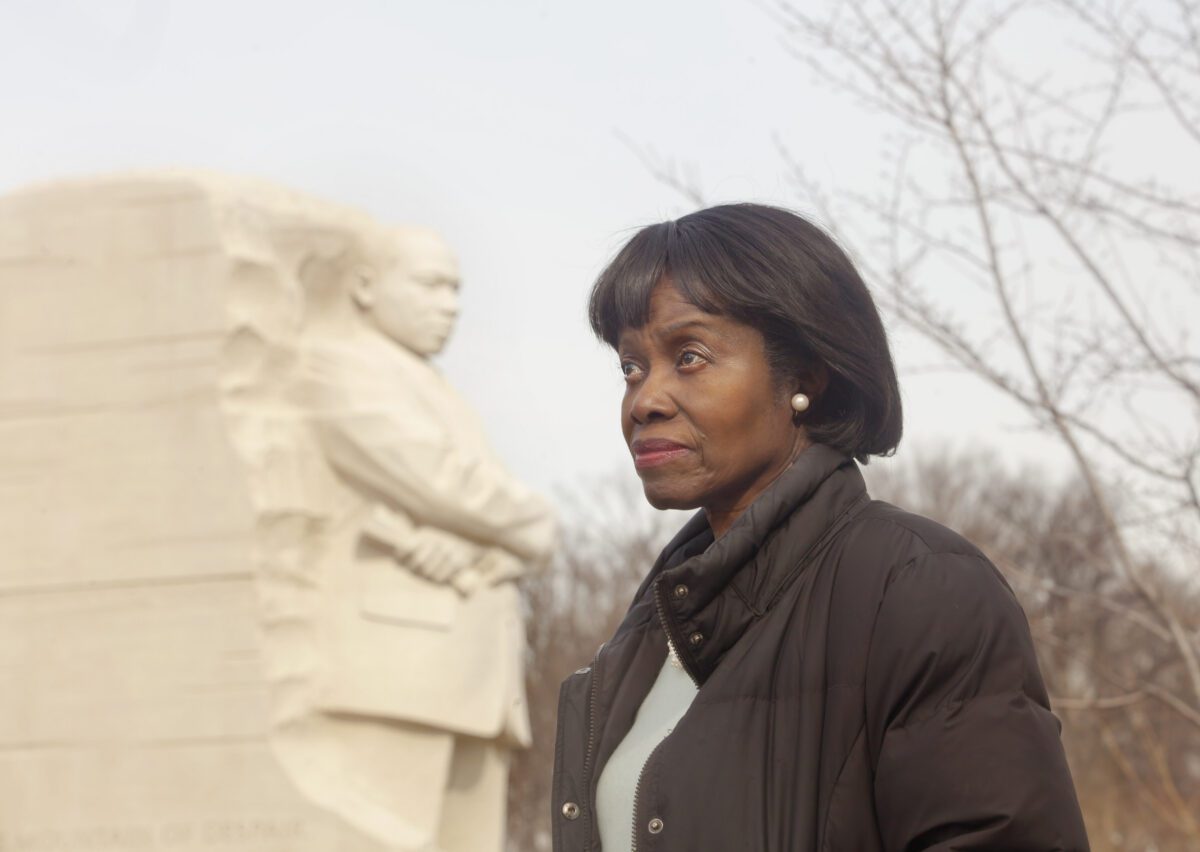
‘Freedom is not free’: a Mississippi native spreads a message of equality across the world
‘Freedom is not free’: a Mississippi native spreads a message of equality across the world
WASHINGTON, D.C. — It was a hot August day 50 years ago in Washington, D.C. The sea of people was so thick that the whites, blacks, Asians and Indians holding hands could hardly move. Ambulance sirens sounded, yet the atmosphere was peaceful — and freedom was in the air.
“It was a celebration,” said 76-year-old Marie Davenport, one of the estimated 300,000 people who gathered for the 1963 March on Washington to heed Martin Luther King Jr.’s historic call for civil and economic rights for black Americans.
“We didn’t know what kind of history it would be, but we knew it was something that would never, ever be forgotten. So, we all came — black, white, all people. We held hands together. We sang together. We prayed together. And, we marched together. And, I think, on that day, people felt united. It was a cause this country needed, because it showed people could come together.”
The march, one of the largest political rallies for human rights in the United States and the stage for King’s renowned “I Have a Dream” speech, was only the beginning for Marie, a black Mississippian brought up to love and respect all people.
“Every time I think about it, it takes me back. But, for me, it didn’t end there. The March on Washington, for me, probably just allowed me to be more and more convinced that I had to get out and do something and not just talk about it.”
Marie, who after the March moved to Germany as a teacher with the U.S. Department of Defense, has traveled the world teaching Dr. King’s philosophy, an extension of her upbringing in Mississippi.
As a young child in Claiborne County, Marie began working the cotton field on her family’s farm. At age 6, she was retrieving water for her family in the field, and by 7 she was picking cotton.
“I learned the value of work. I learned the importance of work,” she said. “I think it gives you a sense of who you are and a feeling of self-worth when you can earn your money.”
Marie had a 20-minute walk on a gravel road to the one-room school designated for black children in her community, near Utica. As she walked, a bus full of white students, sometimes calling names to the black children through the window, would speed past.
Respect for other people, regardless of color, was instilled in Marie by her grandmother, Bettie Davenport, a no-nonsense, strict, yet loving caregiver to the entire community. “Mama,” as she was known, raised Marie.
While Marie, the great-granddaughter of a slave, didn’t experience racism to the degree King often cited around the South, she was aware she was living in a land of separate and unequal. That became even more apparent when she was 12 and her grandmother told her she could no longer be friends with Deanna, a white girl she had played with since she was 8.
As an eighth-grader at Midway Junior High, Marie wrote a speech on a typewriter her grandmother bought for her. “Yes, time marches on and we, the sons of a cruel and heartless society, march along with it,” she wrote. “The sun promises a much brighter day for tomorrow.”
In 1956, upon graduating from high school, she moved to Toledo, Ohio, to live with extended relatives. “I never wanted to go back to the farm after arriving in Toledo,” she said. “I often tell people I didn’t know I was poor, and I really mean that, because everyone around me lived like me.”
After finishing beauty school in Ohio, Marie moved to Washington, D.C., in the summer of 1962. She worked at an all-white beauty salon shampooing hair, and later became a manager at Albert’s Beauty Salon, run by a Jewish man. “Once my employer made me a manager, a lot of whites who lived in the community didn’t like it. They threw eggs all over the shop. They bombed the place,” she said. “But, of course, I didn’t quit.”
It was there in 1968 where she heard the news that Martin Luther King Jr. had been assassinated in Memphis. “When Dr. King was assassinated, I was angry. I felt threatened,” she said. As she walked later along 14th Street and Florida Avenue, she witnessed the D.C. riots. “What I saw was smoke and burning and people — it was a very sad time for me,” she said, choking back tears.
Marie was given the chance to spread King’s message beyond the American border when she learned about the opportunity to teach overseas. In 1974, she went to Frankfurt, Germany, where she taught English at Frankfurt American High School and started a cosmetology department. While there, she ended a case of de facto segregation in the American military beauty salon in Frankfurt.
Marie is frequently asked to speak to groups in Germany about her role in the Civil Rights Movement in America. Through it all, she returned to her Mississippi home about every two years until her grandmother died in 1984, and she continues her pilgrimages home. “I still see it as my home, and I tell people that’s where I’m from,” she said. “I’m still proud of being from Mississippi.”
On her last visit, she brought her husband, Rudi Schneider, a German she met while overseas. “When I got off the plane and I saw that the airport had been named for the civil rights leader Medgar Evers — it was extraordinary,” Marie said. She visited Second Union Church, the burial site of her great-grandfather Tom Scott, a slave who fought in the Civil War and whose name is listed on the wall of the African American Civil War Memorial in D.C.
Marie was one of 20 March participants selected to wear a red ribbon during the 50-year anniversary celebration in August. “I think his method of nonviolence stood out among the rest. Dr. King’s philosophy, I think, was the most successful way,” she said. “And, his message has been carried throughout the world.”
And, it’s working — even in Mississippi, she said. “I see a change. I’m happy about that. Somehow, I believe we are growing closer together as a people in this country,” Marie said. Her husband, Rudi, agrees. “We live Dr. King’s dream — black and white together,” he said.
