

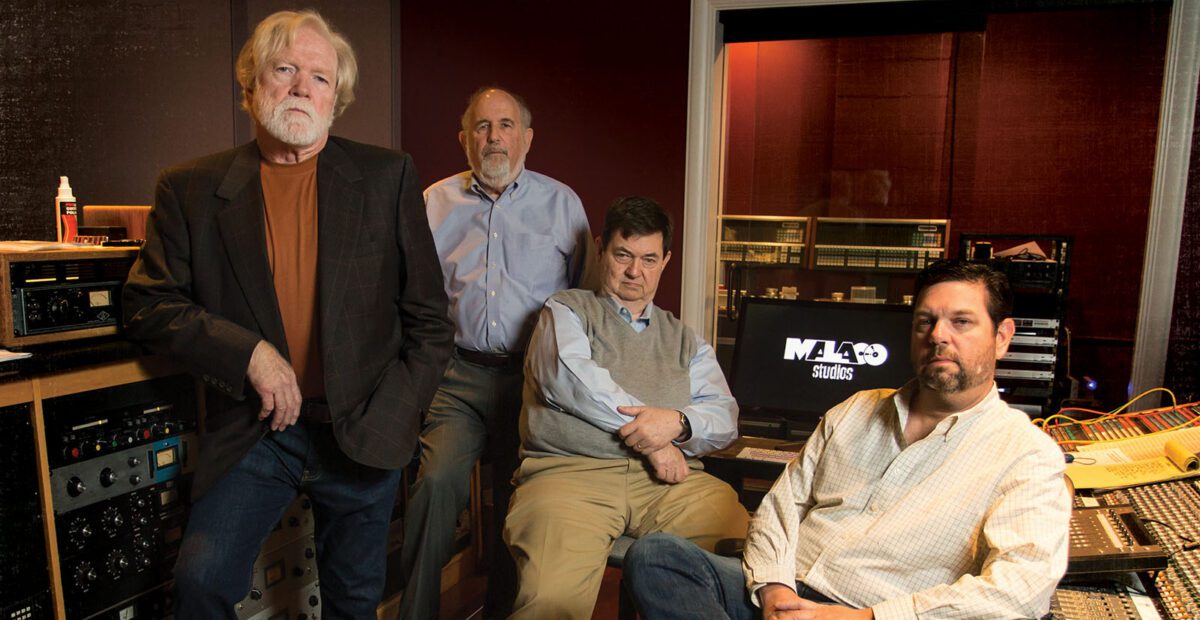
Photographs by Ron Blaylock
A 24-by-22-foot image of Mississippi Fred McDowell looms large from the wall in the vaulted ceiling at the center of Malaco’s offices — a tribute to the blues singer whose music set a path that holds true today.
Known as “the Last Soul Company” (a title taken from music critic Peter Guralnick’s writing), Malaco has survived a tumultuous, fickle field by sticking to business rather than chasing hits and trends, and continuing to fuel a passionate niche.
A Mississippi Blues Trail marker greets at the gate of the studio founded on Northside Drive in Jackson in 1967, sharing the story of one of the foremost labels in Southern soul, blues and gospel music.
With the 1968 creation of Malaco Inc., as a touchstone, Malaco will celebrate its 50th anniversary this year. Details aren’t set, but goals include special vinyl releases, a coffee table photo book, a big gospel celebration concert and events throughout the year.
“While we’re celebrating the last 50, we’re still moving forward,” says Malaco president Tommy Couch Jr.
The legacy is intact.
“They took up the mantle for what we call deep soul at a time when a lot of the larger companies had abandoned it” in the mid-’70s, said blues music historian Scott Barretta. Sounds long identified with Stax and Hi ebbed, displaced on the charts by newer waves, including disco. But, “Not everyone stopped liking that kind of music” and Malaco kept the desire fed.
Scores of Grammy nominations line the walls, and movie posters signal soundtrack use of their songs. The studio bears a reminder of the movie, “Get On Up,” filming a scene there.
Malaco’s struggles, successes and stories are part of its lore. The seeds for Malaco were set in college at Ole Miss, where fraternity brothers Tommy Couch Sr., and Wolf Stephenson booked bands for dances. Later in Jackson, Couch Sr., and brother-in-law Mitchell Malouf started Malaco Attractions. Stephenson joined them in concert promotion, and the recording studio followed
Music was the focus “and that’s about as pointed, I guess, as it was,” founder Couch Sr. said, but they recorded just about anything at the outset, including country music and lectures by University of Mississippi Medical Center’s Dr. Arthur Guyton.
“‘Anesthesia Rounds,” said Stephenson, who became Malaco vice president, recalling an early title.
At some point, a favorite thread became a direction. “The rhythm and blues, soul music — whatever the name du jour was at the time — was what we liked better and what we were probably more successful at,” said Couch Sr.
Prompted by another’s success with Delta blues, Stephenson suggested recording Fred McDowell. The McDowell sessions were released to Capitol Records, and his album was nominated for a Grammy, scoring Malaco a bit of national attention.
Jingles, concert promotions, band booking and studio rental were the studio’s mainstay, but in 1970, New Orleans producer-arranger Wardell Quezergue, who had artists and songs, needed a studio, musicians and funds to record, “and he would share the spoils with us,” Stephenson said. A week of recording music tracks and a marathon weekend of artists, who traveled up from New Orleans in a borrowed school bus, paid off.
Eventually Stax and Atlantic turned down their top picks on first listening, leaving the Malaco crew dejected. Determined, they decided to put one out on a 45. See what happens.
“We picked King Floyd. … To show you how really sharp we were, the one we picked out for the A side was not the hit,” Couch Sr., recalled with a laugh.
Floyd took the record to his buddy, a top New Orleans soul disc jockey, who took it home. There, the B side stayed in constant rotation at his teen daughter’s slumber party. Monday morning, he called to predict, “Man, have you got a hit. This ‘Groove Me’ song is unbelievable!'”
“When he put it on the radio, it just exploded,” Stephenson said. Atlantic called and made a deal for distribution. They scrambled to finish an album to follow. Stax, recalling their initial pass, circled back to release Jean Knight’s “Mr. Big Stuff,” which also blasted off. Both were big hits, probably selling 2 million copies apiece, Couch Sr., said
“We thought it was going to be easy after that,” Stephenson said. “It was, for a minute.”
The Pointer Sisters from Atlantic, Rufus Thomas and others from Stax and, in 1973, Paul Simon (for “There Goes Rhymin’ Simon”) all recorded there for the Malaco touch.
The fire was lit, but it started dwindling about 1974 and lean times returned. Malouf left the company.
“Then we recorded Dorothy Moore’s ‘Misty Blue’ and sort of the same thing happened,” Couch Sr., said. “We couldn’t get anybody interested in it.”
It was on the shelf for a year, with early disco the prevailing wind. The song was still their best shot. They got it mastered and pressed, but with “enough money to send it out with first-class postage and that was about it,” Stephenson said, little promotion. But they got it on the radio in Jackson and a bunch of small stations and it took off. TK Productions of Miami handled distribution.
“Misty Blue” was an R&B and pop hit, selling 2 million or more singles and earning a Grammy nomination. Moore earned another for “I Believe You.” Fern Kinney’s mid-tempo “Together We Are Beautiful” hit big in England, then other countries in Europe. A disco remake of “Groove Me” hit big, too.
Writer/producer Frederick Knight brought Anita Ward to Malaco in 1979 to record. “There was one song on there, we thought was a cute song. Everybody else eventually thought that was a have-to-have song, and that was ‘Ring My Bell,'” a huge hit, Stephenson said.
Stewart Madison joined the company in 1979 as director of business affairs, while Couch and Stephenson focused on the creative end.
Pioneering African-American promoter Dave Clark, well-respected in black radio circles, was hired in 1980, and was instrumental in getting Z.Z. Hill and more to Malaco. “He just fit what we were doing at the time,” Couch Sr., said of their blues/soul stamp.
Records and radio were crucial for artists to boost appearances and fees that were their livelihood, and as the mainstream moved in other directions, Malaco continued to feed fans’ appetites for artists who were already established when they arrived.
Z.Z. Hill’s “Down Home Blues” broke the mold on blues’ “brown-paper-bag/under-the-seat” reputation at the time, Couch Sr., said.
It signaled recognition of a market for old-style blues and soul music, which had become a subgenre of R&B with Malaco the leader in the field, Barretta said.
Artists Hill (until his 1984 death), Denise LaSalle, Latimore, Little Milton Campbell, Johnnie Taylor, Bobby Blue Bland, Shirley Brown and Tyrone Davis, key songwriters and the house band’s soulful grooves cemented Malaco’s niche and dominance in Southern R&B, blues and soul.
“We had our hands full, producing all these soul and R&B artists, up through the ’90s,” Couch Sr., said.
“At the same time, since 1975, we were up to ears in gospel music,” Stephenson added. “Just like Dave Clark had done with the blues artists and soul artists, (Jackson Southernaires’ and Malaco gospel director) Frank Williams had the same effect on the black gospel artists. Almost all of them came because of him.” Williams also founded the Mississippi Mass Choir.
That’s the other piece of the “Last Soul Company” title, said Couch Jr., who joined the company in 1992. “Malaco wasn’t trying to be anything else. It was just concentrating on what it did really well.”
Couch Sr., has an explanation: “We were one of the last companies that made black music for black people. And, if it spilled over or crossed over, it kind of did it on its own.”
Malaco’s challenges since mirror those across the music industry. “People really don’t buy records anymore,” Couch Jr. said. Counterfeiters and bootleggers were the problem in the 1990s, then illegal digital downloading as technology changed.
“Like everything, we kind of took a step back and realized where we were at the time, and embraced it,” Couch Jr., said. Now, they’re direct with digital outlets across the country and in other parts of the world.
Acquisitions were good moves, too, for Malaco, including part of Select-O-Hits, Savoy Records (placing Malaco with the world’s biggest gospel catalog, Couch Jr., said), Atlanta International and Muscle Shoals Sound Studio and publishing.
When an April 2011 tornado destroyed most of Malaco’s offices and studio, “44 years worth of experiences were gone in 44 seconds,” Stephenson said. About 20 people on the property escaped injury. Thanks to a tape vault built, “in our infinite wisdom,” to withstand a tornado, so did the masters.
It brought an opportunity to lay things out and get ready for the coming decades. Best thing? Great insurance. They rebuilt.
“As a lot of people say, especially in the last five years, content is king,” Couch Sr., said. “We luckily have a whole lot of content here, both publishing and masters.”
And, as licensing for commercials and TV or movie use, that’s, as Stephenson said, “forever valuable.”
Couch Jr., glanced across the table at Couch Sr. and Stephenson. “Just the fact that these guys were talented enough to make great records and smart enough to understand the business and to keep the important things important, is really why we’re still here, and actually thriving.
“We’ve become pretty good at embracing changes, and been pretty blessed along the way, too.”
STORY Sherry Lucas
PHOTOGRAPHY Ron Blaylock
