

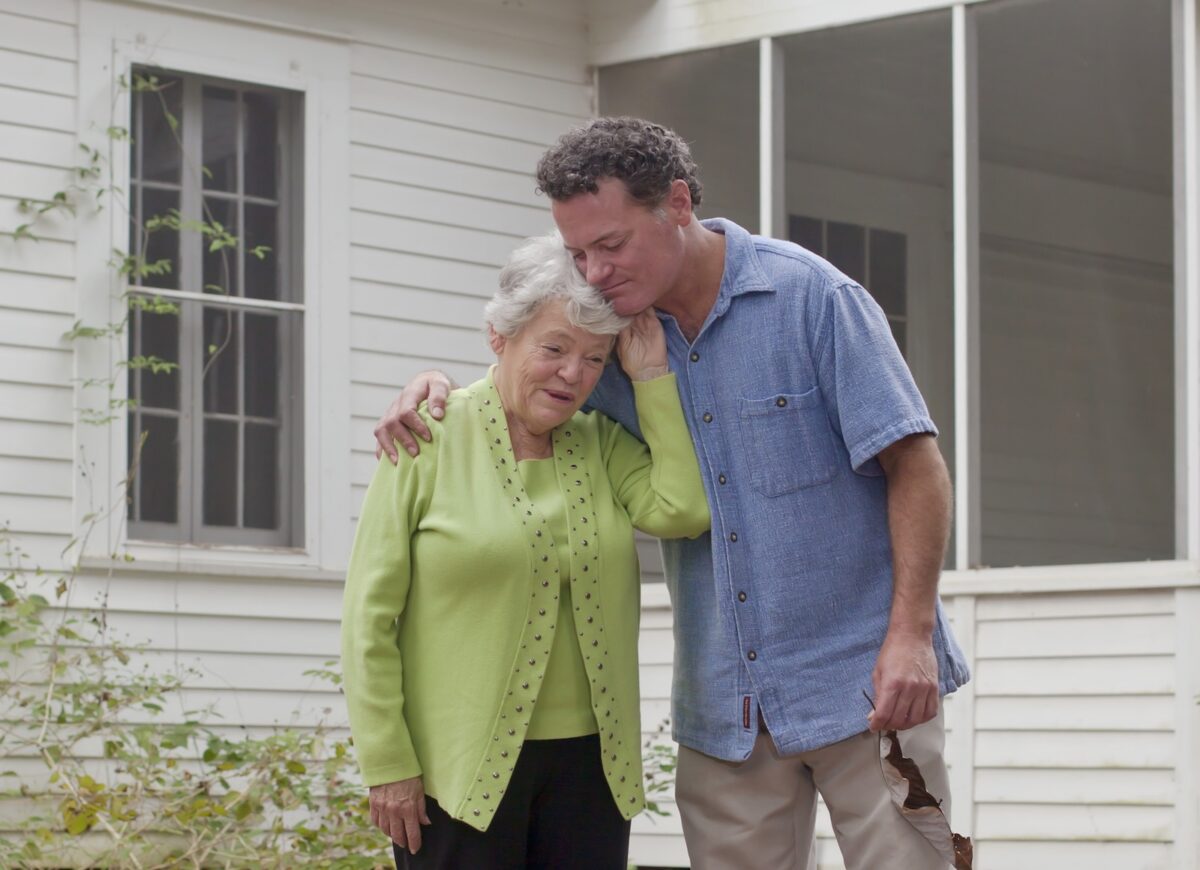
Famed artist's daughter and grandson are connected through art & nature
Photographs by Melanie Thortis
“The art of the past is our inheritance and, unless we accept that inheritance, we are being fools.”
Walter Anderson
OCEAN SPRINGS — Every once in a while 77-year-old artist and retired educator Mary Anderson Pickard will paint something and think, “I’d like to show this to Daddy.”
“But, not very often,” she laughed.
Perhaps it’s because her father, Walter Inglis Anderson, was one of America’s most skilled and prolific painters and artists. Anderson, who lived most of his life on the Mississippi Gulf Coast until his death in 1965, left behind a massive collection of work that is still collected and celebrated throughout the world.
“He’s one of those few giants among men,” Mary said of her father.
The oldest of Walter and Sissy Anderson’s four children, Mary dedicated much of her adult life to raising awareness of her father’s unmatched talent. Now, she and her son, artist Chris Stebly, are carrying on Walter Anderson’s legacy through their own art and a shared love of nature.
“Mama and I share the art part and the going outside together and birding and looking — paying attention,” said 47-year-old Chris.
By observing her father, who was constantly immersed in the nature around him, Mary learned to see things differently.
“When I was a child, my father — for at least the first eight years of my life — lived pretty much with us at Oldfields in Gautier. He would sit on the ground and draw horses or chickens or cats, and he didn’t mind a bit if we sat down and watched,” she said. “And, it was fascinating to watch him draw, because he was magic.”
“He was not a very fatherly man, but he shared his enthusiasms for birds and for wildflowers, and I learned a great deal from him — not because he was teaching me or being fatherly, but because he was so enthusiastic about the things he was enthusiastic about — walking the beach and finding Indian things,” she said.
Paying attention was — and still is — a way of life in the Anderson family. It’s something Mary said she tried to pass down to her own children, who, like their grandfather, spent time immersed in the nature at the uninhabited Horn Island, just 12 miles from Ocean Springs.
“It was actually sinful not to pay attention when the dewberries were ripe. And, to ignore the blooming of the Pitcher plants — good gracious — that was not something you did. You had to be aware of everything that was going on around you. It’s the awareness that makes the difference.”
It was Chris, perhaps more so than the others, who seemed to really feel drawn to Horn Island like his grandfather, who would row out to the island in a small skiff to paint and live primitively for weeks at a time.
“I started seeing all the same creatures and the trees and the plants that are from my grandfather’s artwork, and it related well,” Chris said. “And, it’s just nice to be there because it’s just so away. It’s just right there, but you’re like on another planet. People don’t appreciate it like we do — for its natural beauty.”
While her father exemplified closeness to nature, it was actually Mary’s grandmother and Walter Anderson’s mother — Annette McConnell Anderson — who taught her to appreciate art and emphasized art being made from nothing.
“She was the one who started me drawing and, particularly, she liked to teach you about design. She would give us circles of cardboard and she would say, ‘Now, put two crabs on that circle,’” Mary said. “And you had to draw two crabs inside the circle so that they fit in the circle and filled it up. And, if you did a good job, she’d give you a split stick of bamboo, so you could make a fan. That was your prize.”
Born just two years after his grandfather’s death, Chris didn’t have the luxury of observing Anderson’s artistic endeavors and draw to flora and fauna. He never received instruction from his great-grandmother either. But, coincidentally or, perhaps, more intrinsically, Chris came to know art in a similar way as his mother, who often encouraged him to draw and, more importantly, pay attention.
Chris spent his childhood at Shearwater, the 24 acres of Anderson family land that was purchased by his great-grandparents in 1918. The land facing the Mississippi Sound in Ocean Springs is the compound where Walter Anderson and his brothers, Mac and Peter, lived, painted and showcased pottery, and it continues as a haven for Anderson pottery and artwork. Even though the spirit of the Shearwater land certainly nurtured Chris, he didn’t start creating his own art until the late 1980s when an artist friend, Stig Marcussen, started teaching him how to draw. At the same time, Chris’ older brother, Mark, had started a guide-fishing charter business on a houseboat he built by hand.
Often left out on the houseboat for a month or so at a time during the off-season, the budding artist and temporary guide fisherman felt the urge to feed his hunger for art, even though the boat didn’t have any paper for him to use for his drawings.
“But, what there was were stacks of paper plates that Mark fed his clients on,” Chris said. “I started on the circular paper plates and found it very satisfying to fill the circle like Mama was saying her grandmother did. It just felt right to me.”
At age 20, straight off the houseboat with a stack of about 45 paper plate drawings, Chris started selling and showing his art. He also received a scholarship to study for a year at New Orleans Academy of Fine Art.
“I learned how to pay attention in a classical way because I’m very bohemian. At the end of the year, I felt like I had made progress, but Auseklis, the main instructor and founder of the academy, he came to me and said, ‘Chris, just go back to Ocean Springs and paint, you Ocean Springs aborigine.’”
Chris’ raw talent makes him a sort of kindred spirit to his famous grandfather, with whom he shares the middle name, Inglis. In fact, Chris’ style resembles that of Anderson, especially when he paints with watercolor.
“I guess I took up a little bit of his technique subconsciously, because it works and it’s sort of simple. Yet, I still feel amateurish. It’s a big shadow to follow, you know — big footsteps. That’s been somewhat intimidating, but if you relax and be yourself, there’s no excuse for not becoming your own. It’s important that I step away from it and go be myself and draw and pay attention. That really helps.”
Mary notices similarities between her father and her son.
“I think that Christopher has an extraordinary gift for watercolor. When he puts watercolor on paper, it goes where he wants it to. It’s sort of uncanny,” she said. “I think what Chris shares with my father is that hunger for art.”
While Chris never knew his grandfather, he has always felt a connection to him and his work.
“I thought he was amazing and legendary. I’m around all this incredible artwork that is very magical, and I always felt comfortable and drawn to his work. It’s fun to look at. And, they’re all subject matter that I love, too — indigenous plants and creatures. It made me happy to be around it.”
Chris Inglis Stebly
Unlike his grandfather, Chris has made a living as an artist. He paints on commission, paints murals and decorates Shearwater Pottery whenever he is moved to do so. While Walter Anderson had an undying need to create art constantly, his creations — many of which were discovered in a locked room of his cottage after his death — weren’t exactly celebrated — or purchased — during his lifetime.
“To me, it’s absolutely wonderful that Chris can make a living,” Mary said. “My father never sold anything. He worked in Shearwater for $10 a week for 10 pots a week.”
Creating art was not always to feed his own desires. He also felt an obligation to create.
“He recognized that an artist has a duty to the public, so he made what he called public art,” Mary said of her father. “His public art was the pottery that he decorated and the figurines that he made, the block prints and the murals in public places.”
Perhaps the most admired of his murals is the one he painted on the walls of the Ocean Springs Community Center. Anderson was commissioned by the city for $1 to paint the intricate mural, which depicts the historical significance of Ocean Springs. The mural is on exhibit in the center, now adjacent to the Walter Anderson Museum, where people come from all over the world to view his work. At the time, though, the community didn’t celebrate Anderson’s creation, Mary said.
His anonymity changed when Bob McKnight, director of the Brooks Museum in Memphis, was in town to judge an art show.
“He saw Daddy’s work, and he just went bananas. He couldn’t believe it. And, he said — immediately — he wanted to mount an exhibit, but they needed to be catalogued. There had to be a complete list,” Mary said.
Mary’s mother and two aunts — Pat and Sara — went to work numbering watercolors until the work became too overwhelming. Mary took over the family collection and began promoting her father’s art.
“That’s how I started. My mother said, ‘We can’t get this catalog done. You’ll have to work on it. I’d teach school all day, and I would work on the catalog at night. That’s when I really got to know Walter Anderson — who he was,” she said of her father. “I would look at something, and it would be so funny and I’d say, ‘That man was a funny man.’” The tenderness of some of it — I would find myself crying at night. I would be crying because the tenderness of the way he looked at something. It was very wonderful for me.”
Finally, in 1968, after the pieces were catalogued, an exhibit, titled “The World of Walter Anderson” was mounted at the Brooks Museum in Memphis. And, the world recognition of Walter Anderson was almost immediate. Many paintings started selling for $60 and $80 and, quickly, they went up to $100 and $200 each, Mary said.
“They were in the thousands after I started, because nobody had really taken time to show them before. And, of course, when art dealers get interested in things then the prices get manipulated,” she said. “But, it was quite dramatic — very, very dramatic. I couldn’t keep up with it full-time — even with a secretary, I couldn’t keep up.”
Mary began working to create the Walter Anderson Museum in downtown Ocean Springs, and she traveled around the country giving talks about her father.
“I have spoken about Daddy all over the country, and I think he’s among people like Van Gogh. He’s on the international level of being a major artist,” she said. “The fact that so much of his work was ephemeral — he, I think, was proud of that. Most artists want their work to last. He prided himself on doing work, like, what had been left on the beach by the last wave.”
The Walter Anderson collection in its entirety yielded an unimaginable number of drawings, paintings, sculptures, block prints, puppets, books and more.
“If you count drawings and all, in excess of 50,000, but my brother, John, says, ‘We’re not supposed to talk about that,’” Mary said, laughing.
Among his collection were what the family calls illustrative drawings — 2,000 drawings from “Don Quixote,” 1,100 from “Paradise Lost” and “only” 100 from “Alice in Wonderland,” to name only a few of the collections.
“He would read at night and turn the pages with one hand and color with the other,” Mary said. “There are many, many, many pencil drawings. There are also ink drawings of flora and fauna. I think most people would be content had they done even an eighth of what he did.”
In 2005, Hurricane Katrina devastated Shearwater, home to the Shearwater Pottery showroom and several Anderson family homes. The storm destroyed five houses on the property, including Mary’s, her father’s cottage and the vault with the family collection. A 20-foot piling rammed through two doors of the vault, destroying a majority of Walter Anderson’s work. Chris, who returned to the compound four days after the storm, said it was a heart-wrenching scene.
“There were watercolors on the ground. There were folders full under this thick, slimy mud. You’d slip on something, and there was a folder full of Walter Anderson, and the colors were bleeding like a Sno-cone,” he said. “It was sickening. That was devastating — surreal, you know. It was an other-worldly kind of nightmare.”
Hurricane Katrina was a devastating blow to family members who had worked so hard to bring recognition to Walter Anderson’s legacy. It didn’t change the notion that art and creating were as natural for the artist as was breathing.
“My mother said he had no choice,” Mary said. “People used to say to her, ‘He never could have done it without you.’ She said, ‘That is a joke. He didn’t have any other choice.’ But, I think she did make it easier. She was just in love with art. Art was her passion. And, he was a real artist and she knew that.”
Much like her father, Mary has never been able to just turn it off.
“I always needed to draw — it was like a hunger. You have to do it. But, I didn’t do very much of it ever. Now, I do it whenever I want to,” Mary said.
After a life spent teaching and showcasing her father’s work, Mary has just now begun to spend time painting. She took it up after the museum was completed and when Chris started painting. He and Marcussen would buy her supplies to encourage her to paint.
“Before that, I had drawn on the weekends, and when I found a spare moment, I would draw, but I never painted,” she said.
Mary and Chris both have artwork on display at Shearwater Pottery, which is now run by the children of its founder, Peter Anderson, Walter Anderson’s older brother. The showroom has an array of creations by the Anderson family, including Walter Anderson’s famed alphabet block prints.
A stroll through the showroom and on the grounds of Shearwater reveals a unifying family theme — a true love of creating and an eternal appreciation for nature. It seems to be a fundamental birthright for the Andersons.
“That thing about the plates and my grandmother and the round circles — that, to me, it’s very potent stuff,” Mary said. “Circles are mandalas, and they’re reflective of an image that comes from inside.”
In order to truly take advantage and accept this artistic inheritance, one must pay attention. Nature seems to present itself to Mary and Chris as it did Walter Anderson. Like a brown thrasher that perches in a tree or a rare monarch flying overhead in December, nature rears its head.
“It’s up to us to see it flying by, though. We have to pay attention,” Chris said.
Mary agrees.
“My father felt, ‘Nature is here. Only the beholder is missing. When the beholder is there, then it’s complete.’”
“And, we have to be the beholder.”
STORY Lauchlin Fields
PHOTOGRAPHY Melanie Thortis
