

VICKSBURG
Sacred place built on a promise, saved by providence
Photographs by Melanie Thortis; illustration and additional photographs provided by Gordon Cotton
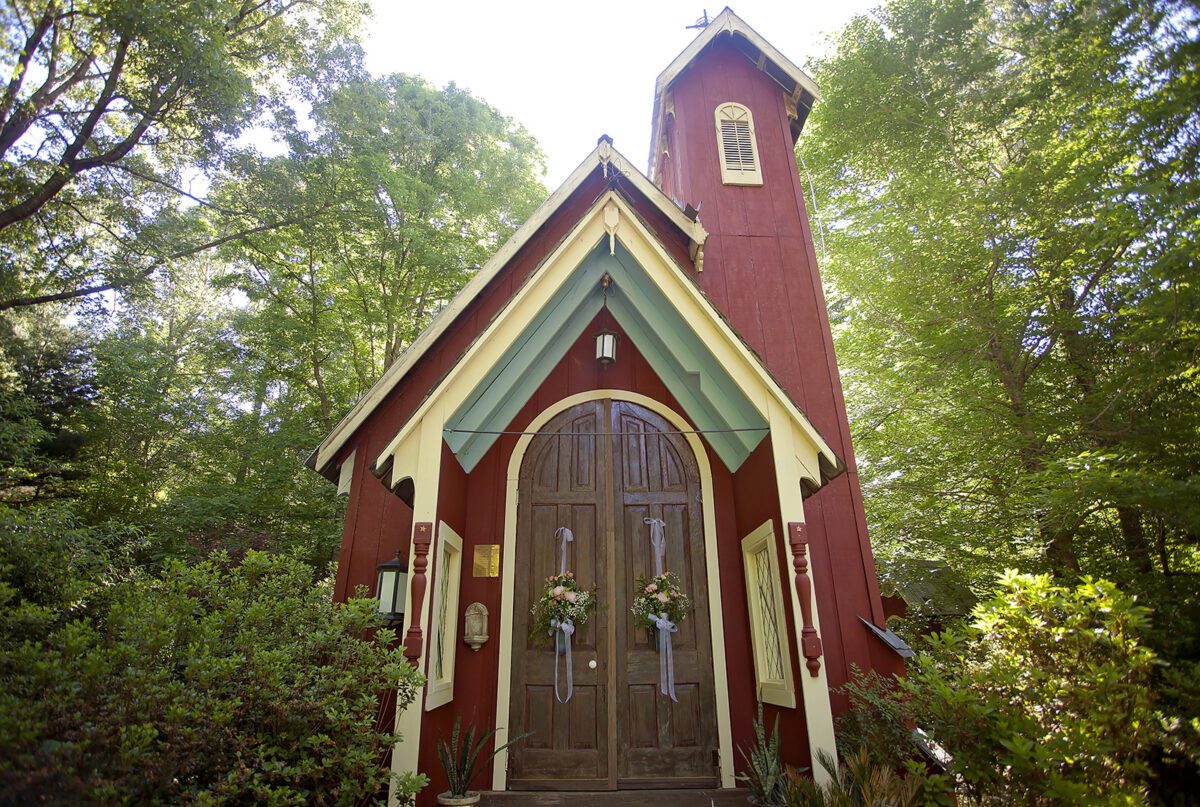
“We’re going to build you a chapel” was a spur-of-the-moment comment that resulted in the construction of a small church in south Warren County.
The late Hobbs Freeman made the promise to Ginnie Mitchell when she was a little girl. When she grew up, she said, she wanted to be married on his tree-shaded lawn.
The expression “cats in the cradle” comes to mind, for it seemed only a few years passed before Ginnie was a young lady, sporting a diamond on her finger, introducing her fiancé, Jay Campbell, and asking “Where’s the chapel?”
I knew when Hobbs said “we” it was an all-inclusive enlistment of his friends. Hobbs lived in Fayette but wanted to move to Warren County, so I had given him land not far from my house. On weekends, he came up and we cleared underbrush, planted shrubs, built a gazebo and an art studio. It was always a big party with lots of food and visiting, as well as work.
Hobbs and I were both collectors of stuff — some said we were pack rats — and, though building a chapel had never entered our minds, we had a pretty good stash of essential items. Years earlier, when a Jefferson County church remodeled, he bought its stained glass windows, and I had homemade pews dating to the 1890s from old Antioch Baptist Church.
We drew our plans. Hobbs insisted on a steep, steep roof, “one that will split rain drops,” and he wanted a bell tower and a balcony. We had no certain size in mind, but the structure had to fit on a gentle slope in a wooded area. Details were not so important — Hobbs was an artist; I, a historian. We would work out the details as we went along. Work began in August 2001.
The foundation timbers were from an old railroad bridge and were 14 feet long, thus the width of the chapel. They were too heavy for us to move, but some visiting college students had them in place in a matter of minutes.
A subfloor served as a work area, and there on site we built the front wall, even painted it and planned to raise it with main strength (and mostly awkwardness). John McHan, Charlie Mitchell, Joe Gay, Hobbs and I soon realized we were no matches for Charles Atlas. My nephew, Pat Forbes, a carpenter, came to the rescue. Pat was in the last stages of cancer, but he sat on the tailgate and directed the placement of pulleys and ropes, which were tied to the truck, and with the greatest of ease the wall was up, looking like a prop for a little theater production.
The walls were easy; the rafters, a little more trying but the next big challenge was the construction and erection of the bell tower.
Hobbs and I built the sides in sections and, with the truck, ladders and ropes, we lifted it into place, a method that would have left professional builders cringing in anguish, some friends in prayer, and OSHA in a twit — but it worked! Soon the roof was on, and it didn’t leak!
Moselle Zimmer had given Hobbs a bell for the tower, and then came the crowning moment: Hobbs had made a stylized copper free-turning cross, and with it over his shoulder he climbed a long ladder to the top and put it in place.
So much was given. My neighbor Walter May, who also collected “stuff,” gave beautiful old doors to panel the interior; and his son-in-law, Steve Brown, spent many an afternoon planing the seasoned walnut boards, which I had been saving for a project such as this. They became the chapel’s floor.
The chapel needed a pulpit. The top of one I had salvaged from mud and termites at Rodney in the 1970s was in my barn, awaiting its time. I built a base, and the chapel had a pulpit. In an Arkansas junk shop, I bought a bowl-shaped brass object for $5. It was a baptismal font in need of a base. Bess Mitchell had the hulk of a parlor organ, its innards all gone, but an electric keyboard was a perfect fit.
We weren’t sure what to do for a front door until on a morning walk down Cherry Street, I saw that the arched 1885 doors that opened from the St. Francis auditorium (now Southern Cultural Heritage Foundation) to the playground were being replaced because of deterioration. Could I have them? Sure, but they’re no good, I was told. So, I repaired them, and they must have been intended for the chapel — another perfect fit! An abandoned church in Red Lick, St. Mary of the Pines, was torn down and Hobbs was given the altar rails, which were just what we needed for the balcony and stairs.
Hobbs made two stained-glass windows, one to go over the nave and the other over the entrance. He also made copper sconces for the walls. Above the organ he hung a light shade of pierced copper made in the early 1900s by the girls at Sophie Newcomb.
There were unforgettable moments, such as the time when Charlie Mitchell lost his grip on a board that bounced and broke a stained-glass window. I must have a dark side, because I let him agonize for a while before telling him there was one spare window.
There was never any question about the name. Hobbs’ great-great-great-grandmother, Emma Kline Freeman Price Bantz, had a chapel on her Tensas Parish, La., plantation that was called Jordan’s (pronounced Jerden), probably for a circuit-riding Methodist who preached there on a monthly basis.
The chapel ceased to exist after the War Between the States and Emma’s death, but it would rise again, reconstituted as Jordan’s Chapel Methodist Episcopal Church, South, a name which my late cousin Alice Luckett thought was “bigger than the building!” Though the denomination by that name no longer exists, it was the one into which Hobbs was christened as a child. He always grinned and said, “I didn’t unite with anybody.”
After about eight months it was time to consecrate the building. The Rev. Michael Nation, a relative of mine who was rector of Holy Trinity, Episcopal, conducted the service, and all who had helped were there. Those were times none of us would forget. Everything that happened, it seemed, was meant to be. It was a very emotional and moving service, and we gave God the glory.
The day came when the praise was fulfilled as the lovely Virginia Ann “Ginnie” Mitchell walked the aisle. It was March 23, 2002.
Over the years, the chapel was the setting for many more weddings, as well as Sacred Harp and gospel singings, carolings, memorial services and times of worship.
All changed when Hobbs became ill and died of pancreatic cancer on June 17, 2009. He was buried in the cemetery he established adjacent to the chapel grounds, his grave marked by a huge carved boulder from a nearby creek. The chapel passed to other hands and it was padlocked by the new absentee owner. When the place was put on the market for sale, we were all concerned about what might happen.
Providence — and my nephew Tommy Forbes — was on our side.
He grew up in Marion County, earned a degree in anthropology from Ole Miss and a master’s from the University of London. He spent time in the Army Security Agency, translating Russian and German. He lived for a while in England before moving to Boston.
Tommy was retiring from a position with Boston University and wanted to come home to the South, “to get away from Yankees and snow.”
What brought him to Warren County were good memories and family ties. He was about 10 when he and his younger brother Mike went exploring, across the ridge, down to the creek and up the hill, where they found a piece of tin and went sliding on some fresh-fallen snow, “having a high old time until Mike ran into a tree.”
He recalls his grandparents’ garden there, of how peaceful and nice it was. Those were good memories that stayed in his head, he said, and he also wanted to get the property back into the family. All of this tied him to the past.
Tommy had known Hobbs, of the chapel being a special place, and he wanted to see it maintained and kept beautiful. He hired Tom McHan of McHan Construction to build his house on the site where Hobbs had planned to build. The place was also special to Tom, for his dad John had a hand in much of the construction of the chapel, and that is where Tom and his wife, Emily, were married. Tommy continues to maintain the grounds and the chapel.
In a way, he said, Hobbs is still around “as I can see him through his work.”
“His spirit is here,” Tommy said.
Four years after Hobbs’ death, his friends gathered in the chapel on his birthday for a memorial service and a time of rejoicing, for only a few days before the chapel was again in the Cotton/Forbes family. Once again it is a place for friends and family to gather, to sing, to visit, to hear the word of God, to say vows, to celebrate.
Jordan’s Chapel Methodist Episcopal Church, South, is one of the prettiest country churches in the state, and it was built on a promise.
STORY Gordon Cotton
PHOTOGRAPHY Melanie Thortis
ILLUSTRATION AND ADDITIONAL PHOTOGRAPHS Provided by Gordon Cotton
