

Near Ruleville — As he drove along the Delta highway, Charles Lee Robinson pointed out a nook of trees rising from a patch of cultivated ground. He grew up there and, off and on, he’s worked this farm for 25 years.
It was a warm September morning, harvest season in the Delta. In the dusty fields, other men were at work — driving combines, removing polypipes, hopping up bare dirt.
Farming is an old profession — the world’s second oldest, some of its practitioners like to joke — and from the outside it can seem simple, even old-fashioned. Maybe that’s why so few young people are entering the field.
“We have two guys who are under 40,” says David Arant Jr.
He drives the truck, carrying Robinson to harvest soybeans on the far side of the Arant family farm.
“Everybody else is over 55. And nobody ever comes to look for a job.”
Yet farming has changed plenty, as Robinson’s nook of trees reveals: his old house is gone now, and he lives back in Ruleville, the closest town. These days Arant and his family use consultants, soil-moisture sensors and combines with computer consoles. As a part of his daily routine, Arant’s uncle Hugh sifts through emails and marketing reports. David marks the fourth generation of Arants to raise crops on this land, which straddles the line between Sunflower and Leflore counties. More than 90 years ago, his great-grandfather moved from Winona to what was then just a patch of swamp. Only 33 now, Arant had planned to avoid this life. After he graduated in 2006 from Mississippi State University with a degree in civil engineering, he took a job with a firm in Jackson.
“I wanted to have weekends,” he said. “I’d been working the farm in the summers. Farming, all you do is work weekends — or Saturdays, anyway. But the first year in Jackson was hard, just being inside all the time.”
He sought as many assignments as he could that would put him outside. At one, the client, an old Delta farmer, started talking about how much he loved his work. Arant began to think of going home.
Four years ago, he sat down with his parents to explain the idea. They resisted — it was a big change, they pointed out — but eventually relented.
“It’s been a blessing,” Arant said. “My dad says it gave him new energy.”
And it’s helped spur one more change on this farm, a sharp break from the way Delta farmers have long viewed their crops. Rather than an anonymous commodity product to be shipped off on a truck, the Arants now approach their rice as a farm-to-table, artisanal product — a food whose whole story you can know.
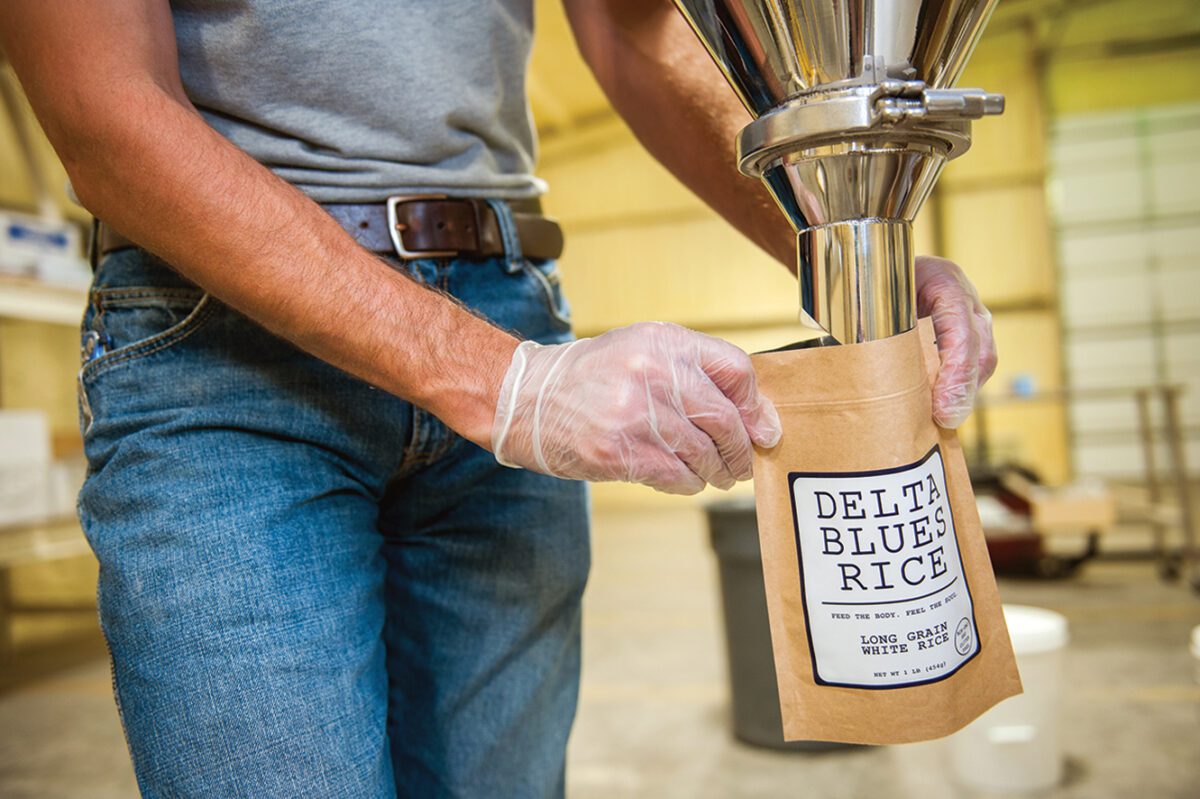
Delta Blues Rice (slogan: “Feed the body. Feed the soul.”) offers brown rice, white rice and rice grits. Each is sold in simple but striking Kraft paper bags. Milled and packed in small batches on the farm, this is a purer product than most of their competitors’ on grocery store shelves, Arant says. A large commercial rice label must pour together different varieties of rice from different farms, while each Delta Blues Rice bag benefits from the consistent flavor of a single rice variety.
Just what rice the Arants use is top secret, but the seeds are developed at a research station in nearby Stoneville and are inspected in the field to ensure quality. The family is now working on certified-organic rice, which requires the fields to be chemical free for three years.
“What we sell now is as close to organic as you can be without certification,” Arant said.
While living in Jackson, Arant became interested in the idea of local food. He frequented farmers’ markets and noticed that some restaurants made an effort to source from nearby farms. Now his family’s rice plays a key role in this.
“It’s very encouraging,” Arant said. “Chefs keep using it, so people must be buying it. That’s a big responsibility, too, making sure you continually put out a good product.”
Farming is a difficult business. It requires huge upfront investments in land and equipment and then the farmers are at the mercy of weather and ever-shifting commodity markets. When the price of inputs, from fertilizer to fuel, goes up, the sales price often stays flat. So margins tighten. Farmers must focus on scale and on the bottom line.
The whole system has its critics, including many devotees of local food. They point out, for example, that despite so much farmland in the Delta, the region produces almost none of its own produce. Delta Blues Rice shows that the farm-to-table movement and large-scale commodity agriculture can co-exist, even on the same farm. Delta Blues Rice is just one part of the Arants’ agricultural portfolio; they raise corn and soybeans, too, and most of their rice crop will be sold as seed rice or for processing at a larger mill.
“Our mill, it won’t even mill a quarter of this year,” Arant said as he drove through the 1,200 acres of rice fields. “We’re a long way from even putting a dent in our rice crop in terms of what goes off the farm.”
But part of the attraction of starting their own label is cutting out the middlemen. By doing more work in-house, the family is adding value to its crop, controlling a bit more of the economics. And if the business takes off, it might create a new set of on-the-farm jobs: marketers and salesmen, for example, which could bring back new generations of the family less interested in the traditional jobs of the farmer.
Across the highway, at a just-cut soybean field, egrets pick at seeds and insects left behind in the dirt. But the rice remains, yellowed at its tops. In bursts, red-winged blackbirds lift as the truck rolls past. The fields would be harvested the following day and then sit empty until April, when the crew returns to “pull the levee” — churning up dirt to create long mounds that contain the fields’ floods.
Rice levees are a common sight in the Delta now, but not so 100 years ago. An important crop worldwide because it provides more human calories than any other, rice is a dietary staple for 3 billion people. As recently as 1956, however, Americans were skeptical. In Louisiana and South Carolina, both of which have a long history of rice cultivation, it was eaten ravenously that year—about 30 pounds per person. Across the nation, however, the average American ate only 5 pounds. In surveys, people declared rice to be bland, hard to cook, unhealthy and too “Chinese.”
Now rice is a proud asset of Mississippi agriculture. Between 2010 and 2014, the state averaged 182,000 acres, almost all in the Delta, for a total annual value of $165 million, according to the National Agricultural Statistics Service and the Mississippi State University Extension Service. Its growth in Mississippi is the result of a few very modern trends, such as advertising. The Rice Council, founded in 1959, successfully rebranded rice as a healthy, cosmopolitan food. Demographics shifted, too, and Americans became interested in alternative diets, which helped familiarize us with formerly exotic foods. Today, the average American eats 25 pounds of rice each year. Almost all of American rice is harvested in just six states, including Mississippi.
Of course, the Delta itself is a modern invention. The region was largely unsettled through the 19th century. To make clearing its swamps worthwhile, early farmers focused on large holdings of proven crops. No one tried rice much until 1948 when a Washington County farmer planted 300 acres. After a few experiments, the crop took and, within six years, 77,000 acres of rice was planted across the Delta.
“Rice has been good to our farm,” Arant said.
Much of the Arants’ soil, heavy with clay, holds water well, making it perfect land for rice. For 35 years now as they’ve rotated crops, the Arants have always planted at least 1,000 acres of rice.
They have long milled a portion of that as a hobby, eating some and giving some as gifts.
“Everybody always wanted more,” Arant said. “We never knew if it was the price or because it tasted better, the price being free.”
Two years ago, in the idle days after harvest, the family began to consider finding out by taking their own milled rice to market. Arant had been back on the farm for two harvests, and his presence meant there was someone on-hand to take charge of the new business.
“Plus I’m somewhat tech-savvy,” he said. “That helps in getting a business off the ground.”
When the new venture was launched in 2014, family members tried to keep using their old mill. That proved inefficient, so they bought a new one, as well as equipment for packaging and labeling, then renovations and insulation for the building. And, this being farming, it took a year before they had a product at all. The costs were much higher than first anticipated.
“Looking back, we jumped in naively,” Arant said. “If I would have known what it would take to get to this point, I might not have done it, but I’m glad we did. It’s been a great learning experience, and I’ve really enjoyed the challenge of growing a business.”
Now he sees real long-term profit potential. The aim, he said, is to get more and more chefs requesting the product, to get the rice into more and more kitchens.
“Just today I’ve talked to two really big distributors,” he said, as he pulled away from the fields and headed back to the shop. “They want to bring it in. I’m very optimistic. There’s a lot on the horizon.”
Not least of all, there’s this harvest. Before the rice can be cut, the combines must be cleaned: vacuumed, then blasted with air, then worked over by hand, using a screwdriver to dig grain out of hard-to-reach spots. Because some rice will be sold as seed to other farmers, inspectors will check the machines; the presence of even a single grain will mean the whole process needs to be done again.
“It’s not an 8-to-5 job,” Arant said. “It’s a 7-to-8 job sometimes.”
Arant’s family enjoys more than selling rice; they enjoy eating it.
“My wife made a rice salad last night, with grapes and tarragon,” he said. “Once you get over the idea that it’s cold rice, it’s so good.”
The family favorite, however, is quite simple.
“Honestly, just rice and butter,” Arant said. “We’re pretty simple.”
STORY Boyce Upholt
PHOTOGRAPHY Rory Doyle
